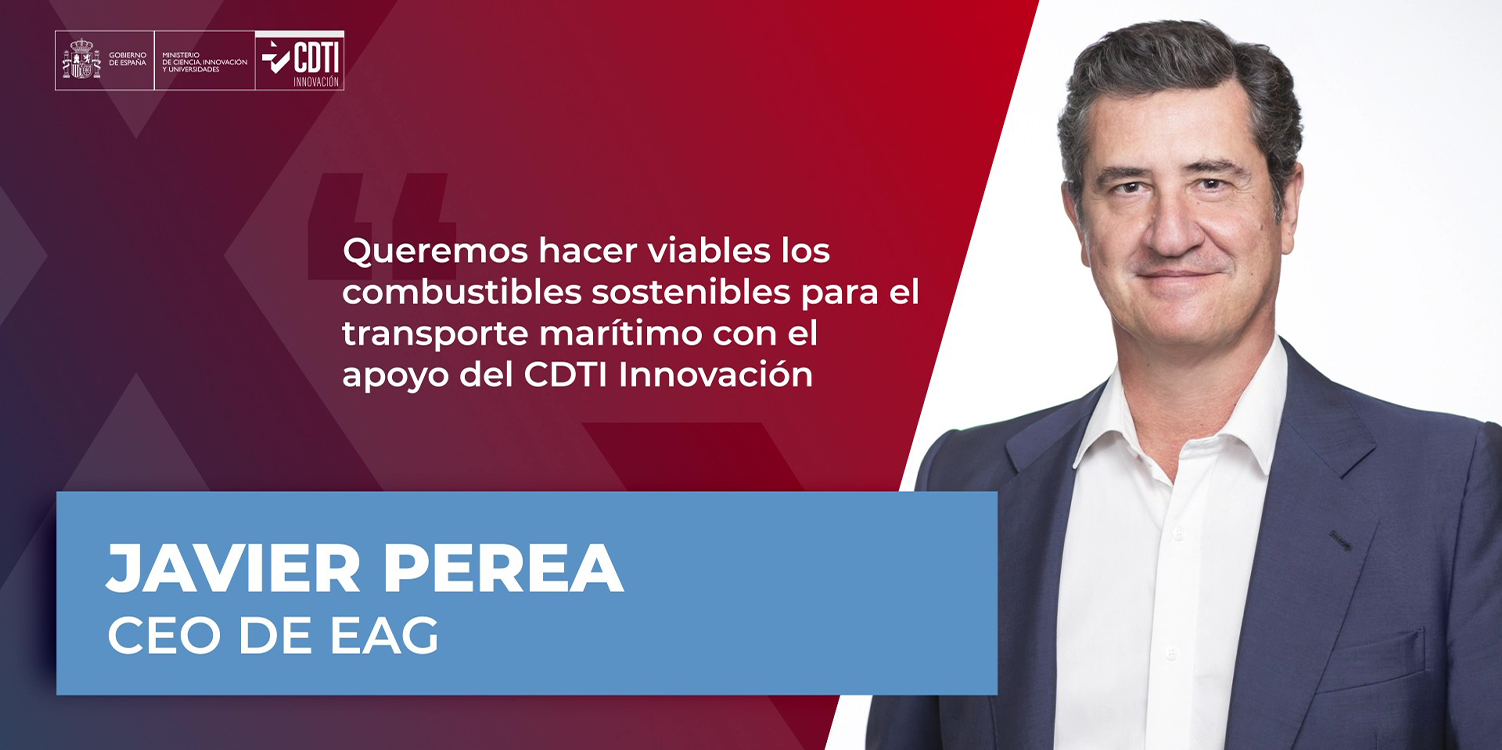
Javier Perea, CEO of EAG: "We want to make sustainable fuels viable for maritime transport with the support of CDTI Innovation"
Entrepreneurs Grouped–GHESA (EAG) coordinates the LUCHA project, an initiative supported by the CDTI Innovation to develop new generation synthetic fuels for maritime transport. The project addresses the entire value chain, from green hydrogen production and CO₂ capture to validation in real engines, with the aim of reducing costs and accelerating the transition to low-emission maritime transport.
The decarbonisation of maritime transport has become one of the great technological challenges of the energy transition. In the marine environment, where the direct electrification of large tonnage vessels is not viable due to long distances, finding competitive alternatives to oil has become a strategic priority. EAG provides a differentiated guarantee: more than six decades of experience putting technical knowledge at the service of projects of very high complexity of energy generation and infrastructures.
The origin of the group is linked to the creation of GHESA Ingeniería y Tecnología, S.A., in 1963, and to that of Entrepreneurs Grouped in 1971, in the context of the development of the Spanish nuclear program. “At that time, Spain needed to have its own engineering capabilities to participate meaningfully in the design and construction of nuclear power plants,” explains Javier Perea, CEO of EAG. “Working in nuclear involves precision, rigour, procedure, traceability, document management, safety culture, coordination between disciplines and strict compliance with international standards. That way of working became a hallmark of the company and a guarantee for customers in other technological sectors,” he says.
This accumulated knowledge has allowed the group to diversify into areas such as renewable energies, large international infrastructures, such as the construction of Terminal 4 of the Adolfo Suárez Madrid-Barajas Airport or the remodeling of the Spotify Camp Nou, and cutting-edge scientific programs such as ITER, CERN or IFMIF-DONES. The group also stands out in the aerospace sector thanks to EcosimPro, its own tool used by the European Space Agency (ESA). “Our mission remains the same as at the beginning: to provide advanced, reliable and competitive engineering to make technically complex projects possible for industry, energy and society,” says Javier Perea.
Economic viability on the high seas
The energy transition in maritime transport requires real alternatives to oil to meet the International Maritime Organization (IMO) goal of achieving net zero emissions around 2050. However, unlike what happens in land transport, the enormous weight and volume of batteries prevents them from being used in ships that travel long transoceanic distances. To address this challenge, the LUCHA project studies the potential of synthetic fuels such as green ammonia, hydrogen or dimethyl ether (DME).
“What we want to achieve is for sustainable marine fuels to stop being a promising but still limited alternative, and start to become a real option for the industry.” To achieve this, the initiative investigates how to reduce production costs, improve energy efficiency, adapt existing infrastructures and ensure operational safety.
Rather than proving that these fuels are technically viable, the challenge now is to facilitate their industrial implementation. To this end, the project works on the main obstacles that hinder its adoption: reducing the cost of hydrogen, improving the capture of CO₂, taking advantage of residual heat and adapting engines and port infrastructures. “The project is not limited to studying an ‘ideal’ fuel in the abstract, but works on the factors that are currently holding back its adoption,” says the CEO.
Artificial intelligence and integration for real efficiency
The great innovation of the LUCHA project lies in its holistic approach, since it does not study the processes in isolation, but as interconnected pieces of the same industrial gear. Green hydrogen and captured carbon are combined by optimized synthesis processes. The ultimate goal is to get as close as possible to what oil derivatives offer today: reliability, ease of use and operational availability, but with a much smaller climate footprint.
The next step will be to manage these new energy systems intelligently. “Digitalization and artificial intelligence will be key to the technological development of energy management systems that will be supported by advanced simulation and modeling tools, optimization methods, and prediction models,” explains Javier Perea.
This ambitious technological development aligns with the UN 2030 Agenda. By driving clean alternatives, the project impacts on SDG 13 (Climate Action), SDG 7 (Affordable and Clean Energy) and SDG 9 (Industry, Innovation and Infrastructure). "If Europe and Spain manage to develop their own technologies to produce sustainable fuels, they will depend less on imported fossil fuels and external technological chains and in the context of the energy transition in which we find ourselves, that is not a technical detail, but a question of competitiveness, employment and economic security," he adds.
A coordinated impulse thanks to the CDTI Innovation
To tackle a challenge of this magnitude, the support of the CDTI Innovation Missions programme has been a “key lever”. According to Javier Perea, this support has not only allowed us to undertake a project of great technological complexity, but also to reduce the risk associated with solutions that have not yet reached their commercial maturity. “Public support is key to navigating that critical stretch between research and industrial scaling,” he says.
On that basis, LUCHA is articulated, a consortium of six companies that cover all the links of the value chain. EAG leads and coordinates the project by contributing its experience in engineering and integration of complex systems; Iberdrola contributes with its capabilities in green hydrogen production and industrial decarbonization; Sistem develops digitalization engineering and intelligent control systems; SKV validates the behavior of new fuels in marine engines; H2Site contributes its technologies of hydrogen purification through membranes; and H2B2 participates with its electrolysis solutions.
For the CEO of EAG, the support of CDTI Innovation also acts as a seal of quality that strengthens the technological credibility of the project. In addition, this consortium model encourages private investment in high-risk developments, favors cooperation between companies, technology centers and the scientific community by promoting knowledge generation, technology transfer and the retention of talent in a strategic area for the industry. "For EAG, the support of CDTI Innovation has been a clearly pulling factor. It has allowed us to approach a project like LUCHA with the ambition and depth that a challenge of this scale requires," he says.
Engineering solutions for the next decade
Beyond LUCHA, the innovation horizon of EAG is to accompany the transformation of the energy model with solutions capable of accelerating the implementation of new low-carbon technologies.
With consolidated experience in more than 80 Power-to-X technology projects aimed at transforming renewable electricity into hydrogen, synthetic fuels and other energy vectors, the group is now focusing its efforts on advanced energy storage, smart carbon capture and the development of hybrid systems for large consumers, such as data centres. “Our strength lies in integration engineering: not only developing a specific technology, but getting different technologies to work together in a reliable, efficient and scalable way,” he concludes.
CDTI Innovation
The Center for Technological Development and Innovation, CDTI E.P.E. It is the innovation agency of the Ministry of Science, Innovation and Universities, whose objective is the promotion of technological innovation in the business environment. The mission of the CDTI is to ensure that the Spanish business fabric generates and transforms scientific and technical knowledge into globally competitive, sustainable and inclusive growth. In 2025, within the framework of the Strategic Plan 2024-2027, the CDTI provided 2,423 million euros of support to Spanish companies and startups.
More information:
Press Office
press@cdti.es
91-581.55.00
On the Internet
Website: www.cdti.es
On Linkedin: https://www.linkedin.com/company/29815
On X: https://x.com/CDTI_innovacion
On Youtube: https://www.youtube.com/user/CDTIoficial
This content is copyright © 2026 CDTI,EPE. The use and reproduction is allowed by citing the source and digital identity of CDTI (@CDTI_innovacion).