María López, CEO of Bitbrain: “The support of CDTI Innovation and European MRR funds allows us to bring home the first personal trainer for the brain against Alzheimer”
Through the ELEVVO project, the Aragonese company Bitbrain leads the development of a pioneering digital health solution aimed at combating mild cognitive impairment linked to Alzheimer. With the financial backing of the CDTI Innovation and the European funds of the Recovery and Resilience Mechanism (MRR), this initiative presents a portable neurotechnology device that allows the patient to see and train their own brain activity in real time from home, offering a non-pharmacological alternative to dementias.
Today, digital health is in the process of transformation towards decentralized medical care that allows effective treatments to be carried out from the user’s own home and thus optimizes public resources. In this context, the transfer of scientific knowledge from university laboratories to the market has become a priority for the bio-health sector.
In this scenario arises Bitbrain, a spin-off of the neurotechnology team of the University of Zaragoza that since 2010 leads this change in the field of applied neuroscience, transforming complex laboratory registration systems into portable and easy-to-use medical devices on a day-to-day basis.
His first academic developments were several pioneering prototypes in the world, such as a mind-controlled wheelchair or a thought-teleoperated robot. These designs generated great interest and expectations at an international level, which was revulsive to make the leap to the market. “We decided to do everything we could to get it into people’s lives,” explains Maria Lopez, CEO of Bitbrain.
To move from the academic to the commercial environment, the founding team opted for self-financing: “We started by providing brain signal measurement tools to researchers, and we have been reinvesting that revenue in R&D so that our solutions reach the patient’s home and have a real impact on their brain health,” he says.
The endorsement of an international trajectory
Before focusing on home care, Bitbrain consolidated its technology in highly competitive international markets. The sale of its first sensors and algorithms to laboratories and multinationals around the world provided the definitive guarantee to certify the reliability of its technology in real scenarios.
As the CEO highlights, one of the company’s milestones internationally was its collaboration with Nissan Japan for the Brain-to-Vehicle project: “Our technology detects in the driver’s brain the intention to brake and sends the order to the car up to 500 milliseconds before his foot reaches the pedal.” In addition, its solution has revolutionized audiology in Europe by allowing objective diagnostics based on the response of the brain, something crucial in babies or people with communication problems.
ELEVVO Project: Neuroplasticity Directed against Alzheimer’s
One of its cutting-edge projects is ELEVVO, an innovative device that addresses the great challenge of the advancement of neurodegenerative diseases against the lack of effective pharmaceutical treatments in traditional medicine.
This project, which has received the support of the CDTI Innovation and the European MRR funds through the Seal of Excellence line, addresses this problem from a different scientific perspective: stimulating neural connections in a personalized way, guided by the patient's own brain activity. “ELEVVO is basically a personal trainer for the brain,” summarizes María López.
 Elevvo allows you to perform exercises to stimulate neural connections from the home
The system consists of a light textile band that reads the patient’s brain electrical impulses in real time, and which is connected to a digital application that guides the user through exercises designed to train specific cognitive functions such as memory and attention. “The system identifies the brain waves linked to memory and attention, and shows you visual feedback on the screen that indicates whether or not you are activating them correctly,” explains María López.
This accuracy is especially critical in the mild cognitive impairment phase. In this intermediate stage, the brain retains the neuroplasticity necessary for a systematic and repetitive practice to help reinforce these neural networks, producing measurable and cumulative changes. This is called “directed neuroplasticity”, as the system detects the pattern of brain signals associated with the cognitive performance of each individual and trains him to activate it above his usual level.
To support the effectiveness of the system, María López highlights the results of a recent clinical study with patients with mild cognitive impairment who used ELEVVO in their homes autonomously for three months. The research revealed a progressive improvement of approximately 60% in neural connections. This increase resulted in a remarkable strengthening of memory (both episodic and working) and clear clinical benefits measured by standard neuropsychological scales.
Unlike generic mental stimulation applications, ELEVVO monitors the user’s exact physiological response and adapts the difficulty dynamically. In addition, the advantage of this system is that the patient can use it completely autonomously at home and the doctor can monitor the evolution of remote treatment without the user having to travel.
Sustainability and circular management in the hospital environment
In order for hospitals and health centers to adopt these solutions, it is key to eliminate economic barriers when buying specialized medical equipment. To solve it, Bitbrain has designed a business strategy based on the pay-per-service model and the circular management of its devices (Hardware-as-a-Service). This approach allows hospitals to integrate this technology without making large initial investments in purchasing devices that could become obsolete in the short term. “The hospital will not buy the device, it will pay per patient treated and for their support. The equipment, at the end of the cycle of use, will be collected, reconditioned and redistributed”, explains the co-founder of the company.
The integration is done digitally: the neurologist identifies the candidate in the consultation and prescribes the treatment; automatically, the medical device is sent directly to the user’s home. During treatment, all information about the patient’s sessions and evolution is stored in the cloud, allowing the doctor to monitor the medical indicators remotely.
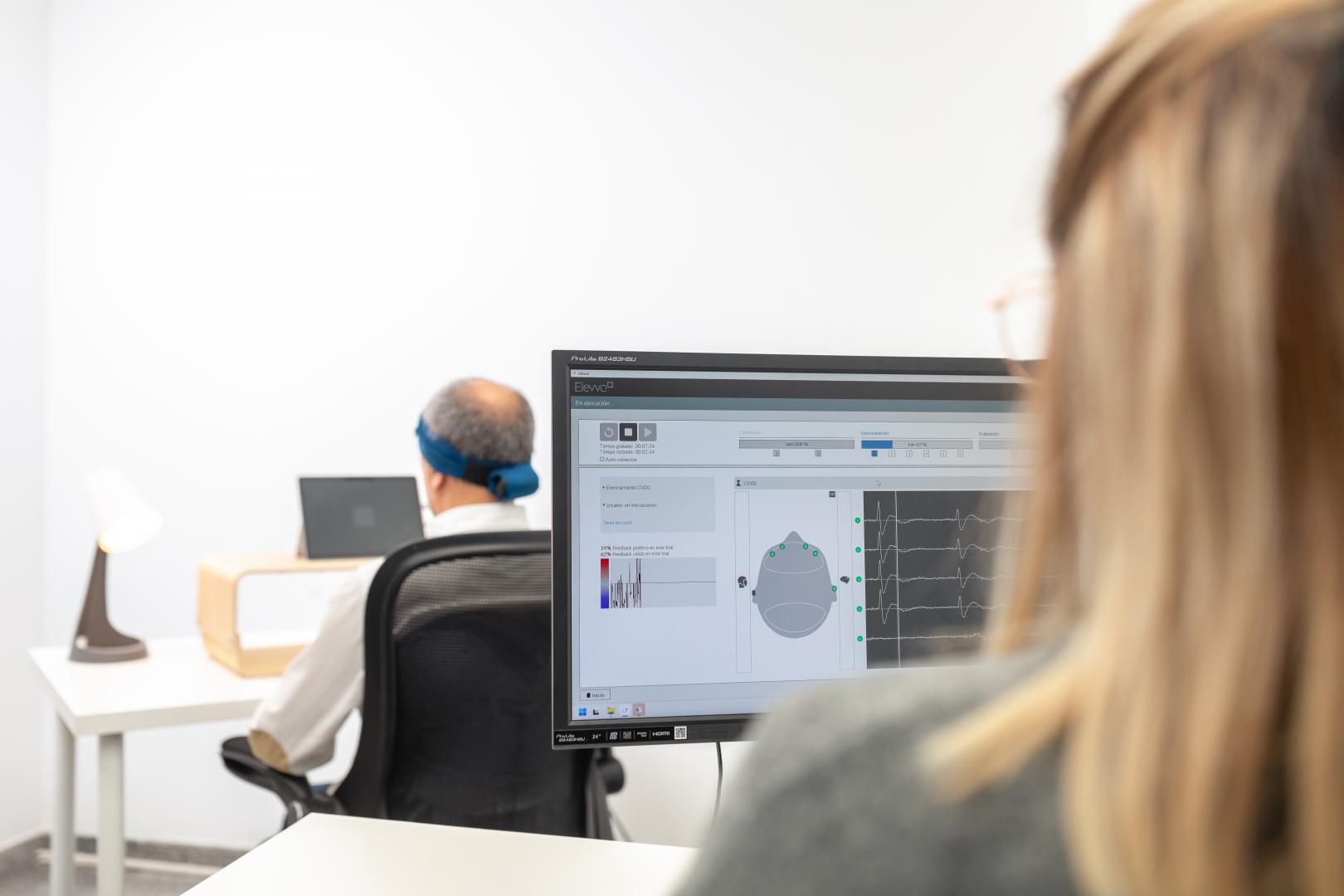 Healthcare professionals can monitor the patient’s evolution remotely
Despite her great potential, María López alludes to one of the great challenges to make a massive implantation a reality: “Medical markings need to be obtained and there is still a long regulatory path ahead of at least 5 years. At the moment, the use being made of ELEVVO in hospitals is always for research purposes.”
A strategic boost thanks to the CDTI Innovation and MRR Funds
Medical neurotechnology development programs involve long, costly research cycles that are subject to stringent international regulatory requirements before they can obtain mandatory medical certifications. In this sense, the CEO describes as “fundamental” the support of CDTI Innovation through its grants Seal of Excellence, a line that finances R&D projects of Spanish SMEs recognized with this distinction of quality by the European Innovation Council within the Horizon Europe program in order to promote technologies that create new markets.
The viability of these innovations depends to a large extent on this funding from public administrations. “This type of research requires a high investment that for an SME is very complicated to assume. In our case, we would not have been able to tackle this project without the support of the CDTI,” says the CEO of Bitbrain.
Applications to other pathologies and development of wearables
Looking to the future, Bitbrain’s roadmap focuses on expanding the capabilities of its ELEVVO platform towards the treatment of other pathologies such as sleep disorders or the rehabilitation of motor sequelae after a stroke. To achieve this, the company wants to advance the development of wearables that not only measure, but also process and interpret information in real time.
In order to drastically lower the cost of manufacturing these wearable devices and ensure privacy by design, the company is moving forward in organic electronics technologies to achieve more flexible and economical materials, and in edge computing to process data on the device itself. In addition, these body sensors will incorporate intelligent models that avoid configuring the equipment for each patient, transparent systems that explain its operation to doctors and privacy filters that protect the identity of the user. “We are working to build the neurotechnological base of the future,” he concludes.
CDTI Innovation
The Center for Technological Development and Innovation, CDTI E.P.E. It is the innovation agency of the Ministry of Science, Innovation and Universities, whose objective is the promotion of technological innovation in the business environment. The mission of the CDTI is to ensure that the Spanish business fabric generates and transforms scientific and technical knowledge into globally competitive, sustainable and inclusive growth. In 2025, within the framework of the Strategic Plan 2024-2027, the CDTI provided 2,423 million euros of support to Spanish companies and startups.
More information:
Press Office
press@cdti.es
91-581.55.00
On the Internet
Website: www.cdti.es
On Linkedin: https://www.linkedin.com/company/29815
On X: https://x.com/CDTI_innovacion
On Youtube: https://www.youtube.com/user/CDTIoficial
This content is copyright © 2026 CDTI,EPE. The use and reproduction is allowed by citing the source and digital identity of CDTI (@CDTI_innovacion).