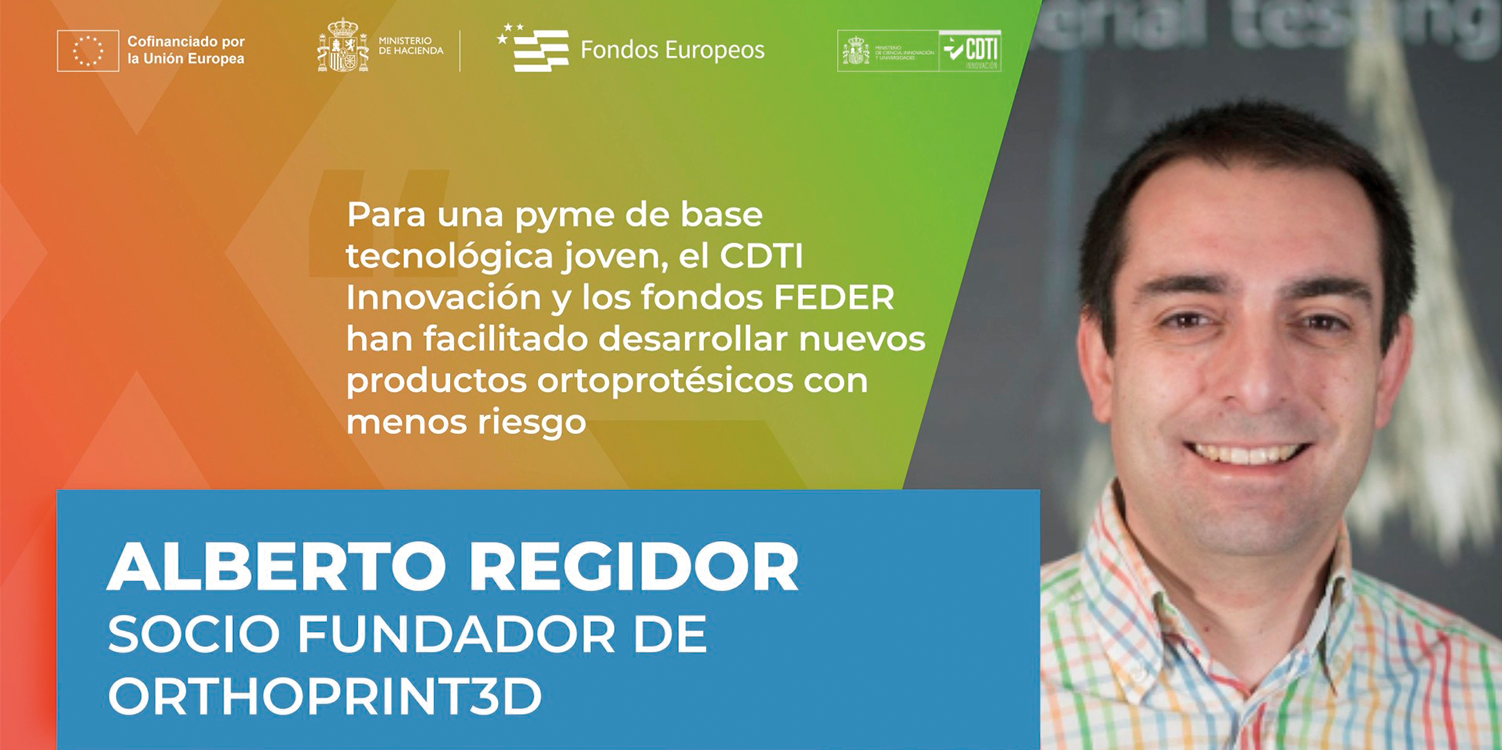
Alberto Regidor, founding partner of Orthoprint3D: "For a young technology-based SME, CDTI Innovation and ERDF funds have made it easier for us to develop new orthoprosthetic products with less risk"
From Castilla y León, Orthoprint3D works to transform the way orthoprosthetic products are designed and manufactured. Its project of development of dynamic ankle-foot orthoses of personalized rigidity, promoted with the support of CDTI Innovation and the European funds FEDER, combines 3D digitization, biomechanics, advanced additive manufacturing and objective analysis of the march to offer more precise, reproducible solutions adapted to the real needs of each patient
The Orthoprint3D company emerged in mid-2020 from the confluence between two seemingly distant worlds: automotive testing and clinical orthopedics. Its founding partners, four engineers from the automotive sector and several orthopedic technicians with experience in the orthoprosthetic field, found that the technologies available in other industrial sectors could radically change the way we manufacture customized medical products. "We wanted to combine technological knowledge, clinical experience and real vision of the orthoprosthetic market," explains Alberto Regidor, founding partner of the company.
Based in Castilla y León, Orthoprint3D today has a team of six industrial, design and biomedical engineers, as well as orthopedic technicians, who are joined by students in practices and collaborations with the university. "This formula allows us to attract specialized talent and help qualified technical profiles to develop professionally in Castilla y León," says Regidor. The R&D area, made up of four people, occupies a central place in the company’s structure: much of Orthoprint3D’s activity is based on the development of new products, the improvement of digital processes and the objective validation of the solutions they manufacture.
Its catalog includes cranial orthoses, custom templates, custom postural seats, hand splints and face masks, all made by 3D printing. In 2025 the turnover rose to 200,000 euros, concentrated mainly in the national market, although the company has already made its first steps abroad with the sending of cranial orthotics to an orthopaedics in Peru and ongoing conversations with clinics in Brazil. The participation this year in OTWorld, one of the European fairs of reference in the orthopedic sector, marks the beginning of a more determined commitment to Europe and Latin America.
A technological gap in the orthoprosthetic sector
The project of development of dynamic ankle-foot orthoses—known as SWOT—was born from an accurate observation. In the traditional orthoprosthetic sector, the manufacture of this type of device still depends to a large extent on the manual work and the individual experience of each technician. "That experience is very valuable, but it also makes the result vary from case to case, with intertechnical variability," explains Regidor. In addition, many clinical decisions are made based on visual observation of the march, without objective data that help define the rigidity, adjustment or the most appropriate behavior for each patient.
The most advanced solutions that exist in the market, such as orthoses with spring or hydraulic systems, offer good performance but have clear drawbacks: they are expensive, bulky and do not always fit within health financing systems. “For all of these reasons, we wanted to propose an alternative: a personalized orthosis, manufactured through 3D printing, that allows to combine precision, repeatability, patient adaptation, sustainability and a more competitive cost,” Regidor summarizes.
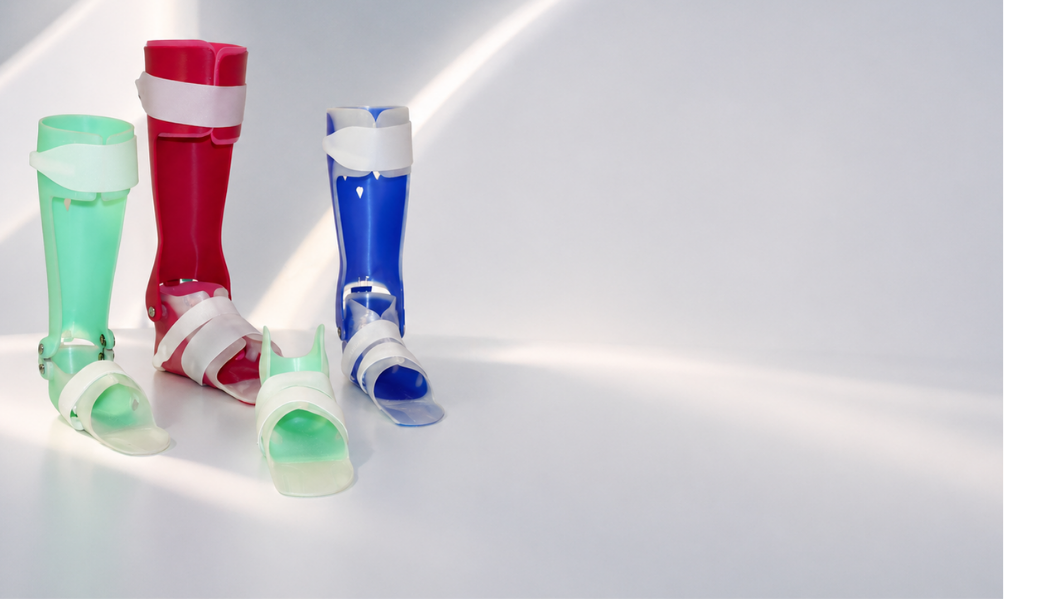
Orthosis foot ankle Orthomedical 3D
Technology that comes together in a single product
What makes this project unique is the integration of several technological disciplines into the development of a single device. The process begins with the 3D digitalization of the patient and the CAD design of an orthosis adapted to his anatomy and continues with the biomechanical analysis of the march to understand how the patient actually moves and what he needs from the functional point of view. From there comes into play simulation, mechanical testing and advanced 3D printing with materials such as TPU, PP, polyamides and continuous fiber reinforcements.
"We are not only looking to make an orthosis that fits the patient's anatomy, but also to adjust its mechanical behavior. In other words, the orthosis has a specific and personalized rigidity according to the needs of each case," explains Regidor. The balance between strength, lightness, comfort and cost is the vector that guides every design and material decision.
To accurately measure how the patient walks, the project incorporates the VICON motion capture system, which allows the behavior of the joints during each step of the foot to be recorded in three dimensions. "This information is much more accurate than simple visual observation, because we can measure how the ankle behaves at every moment," says Regidor. Added to this are instrumented templates to measure plantar pressures and sensors that study the contact between the orthosis and the leg. The goal is for the device design to be based on data and not just on a subjective assessment.
The challenge of controlled rigidity
If there is a technical challenge that concentrates the complexity of the project, it is to achieve that a 3D-printed orthosis has a personalized and controlled rigidity, but that at the same time is resistant, comfortable, light and economically viable. "Stiffness is a key aspect, because it directly influences the patient's way of walking. If the orthosis is too rigid, it can limit the movement; if it is too flexible, it may not provide the necessary support, so we have to look for that balance," Regidor describes. To address it, the team works in parallel in several lines: material selection, design of mechanisms of variable stiffness, fatigue tests, mechanical tests and analysis of the relationship between the angle of movement of the ankle and the resistance offered by the orthosis.
In short, it is not a question of manufacturing a 3D piece, but of making that piece have a very specific functional behavior and adapted to each patient. That level of demand is precisely what makes collaboration with the University of Valladolid necessary. "From Orthoprint3D we bring the knowledge of the orthoprosthetic product, the experience in additive manufacturing and the practical vision of what the market and the patient needs. The University provides scientific and technical knowledge in biomechanics, materials, mechanical testing, fatigue, simulation and gait analysis," explains Regidor. This alliance allows innovation not to remain an idea, but to become a real, validated and applicable solution.
It is in this context that the support of the CDTI Innovation and the European ERDF funds has been decisive. "For a technology-based and newly created SME like Orthoprint3D, this type of aid is a fundamental instrument to accelerate the development of new products and reduce the technological risk associated with high-complexity R&D projects," says Regidor. This funding has allowed us to invest in equipment, materials, testing, software development and contracting specialized technical profiles, but also to generate our own knowledge. "Thanks to this type of financing, a young company can tackle developments that, due to their level of technical uncertainty and need for validation, would be difficult to assume only with its own resources," he adds.
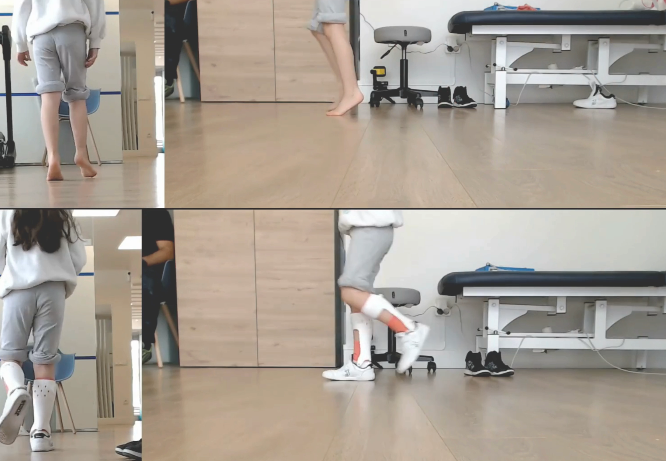
recording example march with and without DAFO orthoses
Personalization and sustainability, two sides of the same coin
One of the most unique aspects of the Orthoprint3D approach is that it is committed to sustainability not as a complement, but as a consubstantial part of the manufacturing process. 3D printing produces only the necessary material, reduces waste and manufactures on demand, avoiding the surpluses of more artisanal processes. The thermoplastic materials with which they work also offer greater possibilities for recycling than traditional systems. "The idea is that personalization is not at odds with sustainability, but quite the opposite: that we can manufacture customized products, more efficient and with less environmental impact," says Regidor.
This project is directly aligned with several Sustainable Development Goals of the 2030 Agenda. Improved access to personalised health products contributes to SDG 3 (health and welfare); waste reduction and efficient use of materials connect with SDG 12 (responsible production and consumption); the generation of skilled technical employment in the territory supports SDG 8 (decent work and economic growth); and collaboration between business and university strengthens SDG 17 (partnerships to achieve the objectives).
The future of digital orthopedics
The ankle-foot orthosis project has a vocation that goes beyond the specific product. "SWOT orthoses are a very important first step because they combine many of the challenges we want to solve: anatomical customization, mechanical behavior, rigidity, comfort, lightness and adaptation to the ride," explains Regidor. If this methodology is validated, the team trusts that it can be transferred to other lower limb orthoses, functional support devices or even custom-made corsets for scoliosis. "The goal is to build a new way of working: more digital, more objective, more reproducible and focused on the real needs of the patient," he summarizes.
The impact of this type of development is not only clinical. Regidor underlines the effect that public funding has on the whole of the innovative ecosystem: "These grants boost the competitiveness of the Spanish business fabric, promote the creation of qualified employment, the retention of technical talent in the territory and the collaboration between company, university and clinical centers." And in projects like Orthoprint3D, that value chain always ends at the same point: the patient. "The development of more precise, comfortable, functional and accessible orthoses can improve clinical outcomes, facilitate the work of healthcare professionals and offer more personalized treatments," he concludes. In this sense, public and European funding not only boosts business activity, but also helps technological advances reach society in the form of better products, better treatments and care more adapted to the real needs of each patient.
CDTI Innovation
The Center for Technological Development and Innovation, CDTI E.P.E. It is the innovation agency of the Ministry of Science, Innovation and Universities, whose objective is the promotion of technological innovation in the business environment. The mission of the CDTI is to ensure that the Spanish business fabric generates and transforms scientific and technical knowledge into globally competitive, sustainable and inclusive growth. In 2025, within the framework of the Strategic Plan 2024-2027, the CDTI provided 2,423 million euros of support to Spanish companies and startups.
More information:
Press Office
press@cdti.es
91-581.55.00
On the Internet
Website: www.cdti.es
On Linkedin: https://www.linkedin.com/company/29815
On X: https://twitter.com/CDTI_innovacion
On Youtube: https://www.youtube.com/user/CDTIoficial
This content is copyright © 2026 CDTI,EPE. The use and reproduction is allowed by citing the source and digital identity of CDTI (@CDTI_innovacion).