Francisco Hierro del Castillo, General Director of Laboratorio Agrama: "The challenge is to detect increasingly complex pollutants in lower concentrations with the support of CDTI Innovation and FEDER funds"
MOSH/MOAH and PFAS are compounds that can be found in everyday applications such as stain coatings, paints, extinguishing foams or food packaging, and that are potentially harmful to human health. However, identifying precisely which specific substances are present in each sample poses a high technical complexity. Laboratorio Agrama has invested in equipment capable of accurately determining these pollutants, both in food and water, in order to assess the associated risks early and inform consumers when their health may be compromised. The project has been supported by the CDTI Innovation through an investment line, co-financed with European ERDF funds, a commitment that connects with the Center’s priority to promote environmental sustainability and the protection of public health in an area, that of the control of emerging pollutants, increasingly relevant to food and water security.
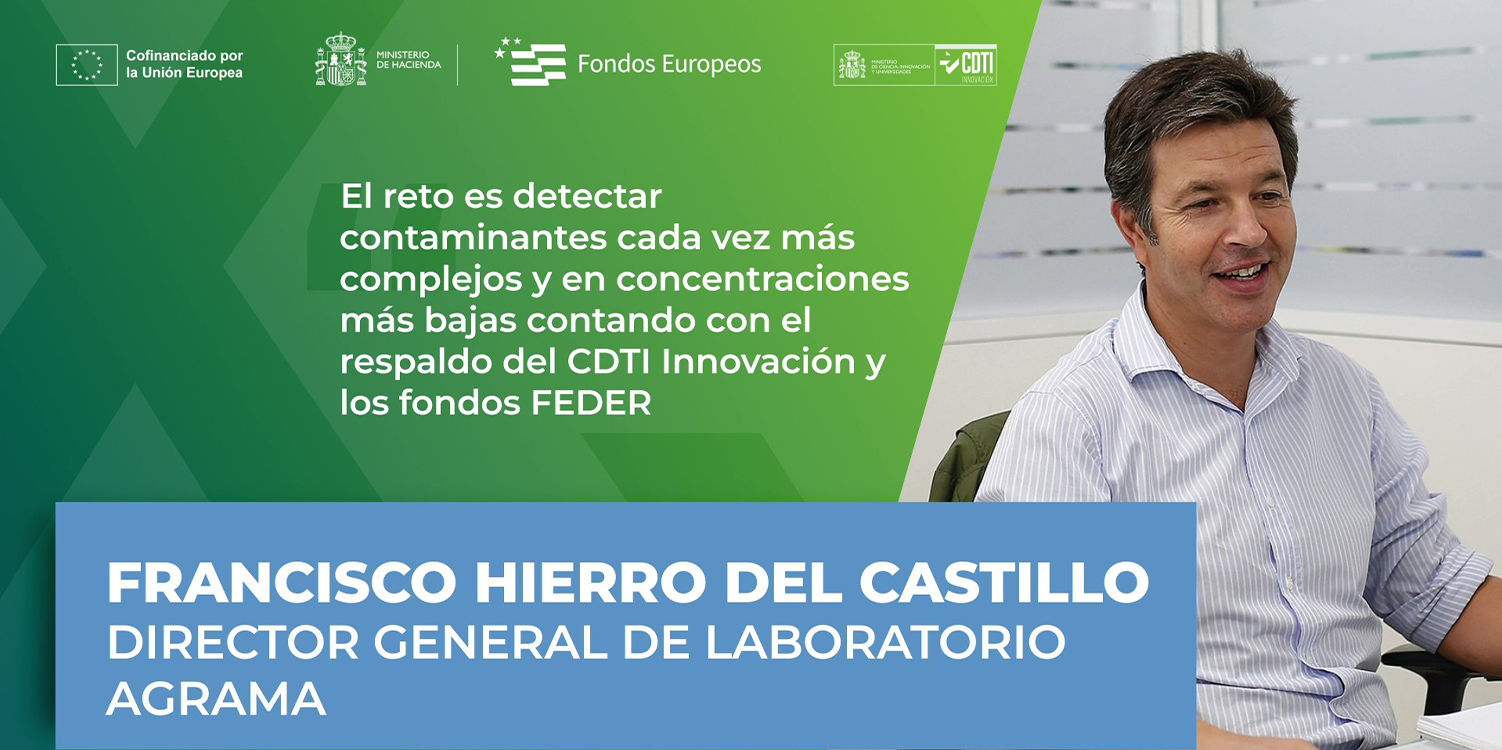
Based in Seville, the Agrama Laboratory was born in 1998 to offer analysis and diagnostic services to the agricultural sector. Since then, it has expanded its services and areas of specialization and has incorporated new technologies to accompany the evolution of sectors such as food and the environment.
This trajectory, also supported by investment in R&D&I, has led the laboratory to strengthen its ability to identify contaminants that require increasingly sensitive and accurate methods. This is intended to respond to a twofold need. On the one hand, an increasingly demanding regulation on control and, on the other, the demand of companies and administrations that need reliable results to assess risks and make decisions. "We detect a growing demand for analysis to comply with legislation that is increasingly concerned with food safety and respect for the environment," explains Francisco Hierro del Castillo, general director of Agrama.
The challenge of detecting and differentiating pollutants
PFAS are fluorinated substances that are used to provide resistance to water, fats, heat and certain chemical agents, so they are present in applications such as coatings, paints or extinguishing foams. MOSH and MOAH are, for their part, hydrocarbons from mineral oils that can reach foods during different stages of their manufacture, packaging or storage. "Their control is important because these compounds can pose health risks and remain for a long time in the environment," says the director.
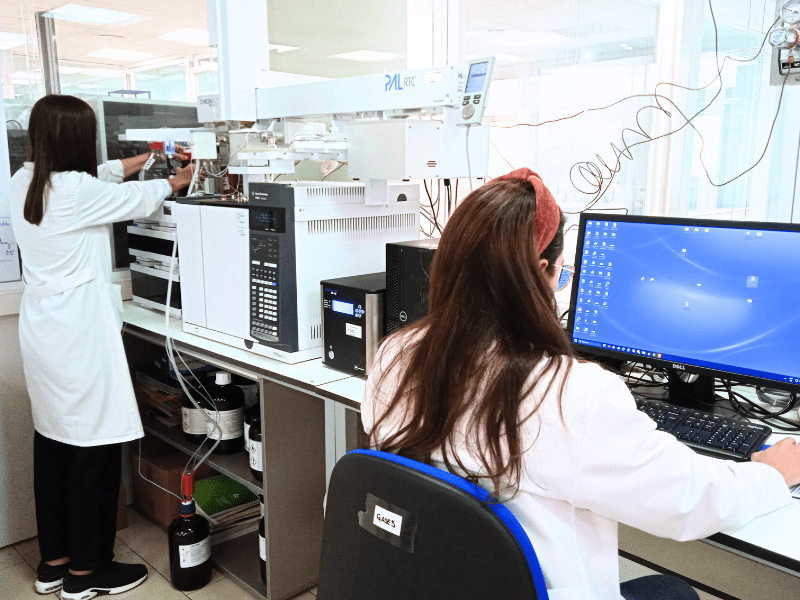
Laboratorio Agrama’s technical team overseeing high-precision analysis
However, the two groups pose different analytical difficulties. In the case of PFAS, the challenge is to detect very small amounts and do so without other components present in the sample interfering with the analysis. In MOSH and MOAH, the difficulty is that under these designations many different compounds are grouped, so the analysis should allow to quantify their presence and determine which specific substances are part of these groups. This is especially relevant in the case of MOAHs, where knowing their composition allows us to better assess the possible risks associated with them.
The technology incorporated by Laboratorio Agrama allows to increase the sensitivity and selectivity of the analyses and obtain results with greater precision, a key advance when working with very low concentrations and with samples whose composition can make identification difficult.
In addition, this project directly connects with several Sustainable Development Goals (SDGs), especially SDG 3, Health and Welfare; SDG 6, Clean Water and Sanitation; and SDG 12, Responsible Production and Consumption.
More sensitivity to detect before and act better
The technology developed by the Sevillian laboratory is especially relevant for those who need reliable information to make decisions about the safety of their products and processes. "It allows us to identify possible contamination earlier, better evaluate the risks and adopt corrective measures more quickly," says Francisco Hierro.
This new solution is already having a positive impact on laboratory activity, allowing to extend the types of samples analyzed, improve the sensitivity and reliability of the results and reduce response times. At the same time, Agrama is advancing in the extension of the UNE-EN ISO 17025 accreditation, which certifies the technical competence necessary to carry out this type of tests according to validated procedures, with guarantees of precision, traceability and quality. The extension of this recognition will officially support their ability to offer these services under an internationally recognized standard.
The incorporation of these capabilities has also opened a new path of activity in the packaging industry, where regulatory requirements are generating new control needs. "This technology has allowed us to enter the packaging industry in response to Regulation (EU) 2025/40 on packaging and packaging waste," says the executive.
The Drive for CDTI Innovation and ERDF Funds
The incorporation of advanced equipment requires an investment that does not end in the acquisition of instrumentation. The development of methods, the training of personnel and the maintenance of rigorous quality control procedures are also necessary to turn this technology into a useful analytical capacity.
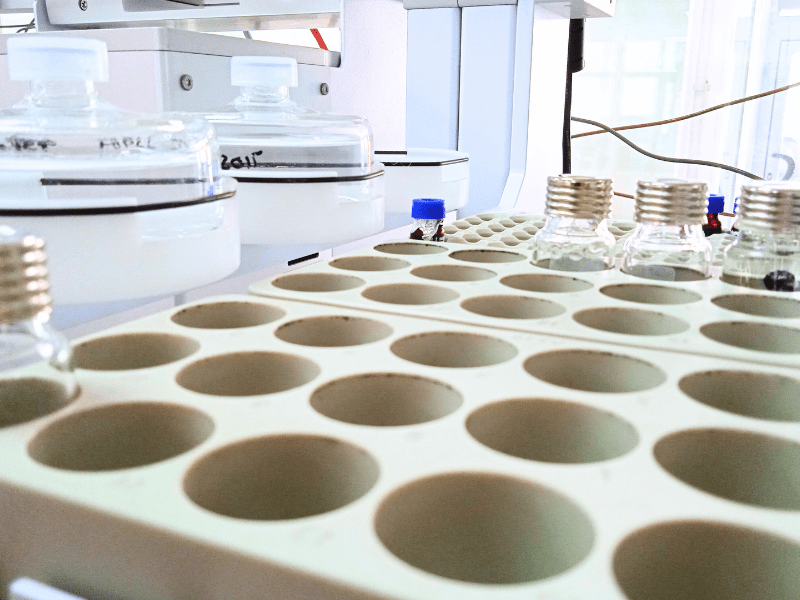
Laboratorio Agrama uses state-of-the-art analytical technology to ensure maximum accuracy in its analyses
In this process, the support of the CDTI Innovation through the Plurirregional Program of Spain (POPE 2), cofinanced by the European Regional Development Fund (ERDF) has allowed the Sevillian laboratory to advance in this line of work. "This support has allowed us to undertake a technological investment difficult to deal with solely with our own resources. It has also accelerated the development of new analytical capabilities and strengthened our competitiveness," says Francisco Hierro.
For the director of Agrama, “the main learning is that technology must be accompanied by methodological development, training and rigorous quality control”. With this challenge in mind, the company now plans to extend the methods to new matrices, incorporate other emerging pollutants and continue to advance its accreditation.
The challenges of the future of pollutant control
As the control of new pollutants increases, so does the need for laboratories to work with harmonised methods, benchmarks and common criteria for interpreting and comparing results. Spain starts from a relevant position because of the weight of its agri-food sector, especially in areas such as olive oil, and because of the technical capacity of its laboratories.
Maintaining this position requires continuing to invest in technology and training, improving surveillance systems and guaranteeing accreditation conditions that allow Spanish laboratories to compete on an equal footing with those of other European countries. Francisco Hierro calls, in this regard, for the need for “the Spanish Accreditation Entity not to represent a competitive disadvantage of Spanish laboratories with respect to those of the rest of Europe”. In addition, it is important that competition between the large global operators in the sector does not undermine the competitiveness of national laboratories, such as AGRAMA, since this is based on continuous price reductions.
The laboratory is now facing a new stage of growth, in which the knowledge acquired during the project will serve as a basis to expand its activity and continue to respond to the needs of an increasingly demanding market. "In the coming years we want to expand the methods to new matrices, incorporate other emerging pollutants and continue to advance their accreditation."
CDTI Innovation
The Center for Technological Development and Innovation, CDTI E.P.E. It is the innovation agency of the Ministry of Science, Innovation and Universities, whose objective is the promotion of technological innovation in the business environment. The mission of the CDTI is to ensure that the Spanish business fabric generates and transforms scientific and technical knowledge into globally competitive, sustainable and inclusive growth.
More information:
Press Office
press@cdti.es
91-581.55.00
On the Internet
Website: www.cdti.es
On Linkedin: https://www.linkedin.com/company/29815
On X: https://x.com/CDTI_innovacion
On Youtube: https://www.youtube.com/user/CDTIoficial
This content is copyright © 2026 CDTI,EPE. The use and reproduction is allowed by citing the source and digital identity of CDTI (@CDTI_innovacion).