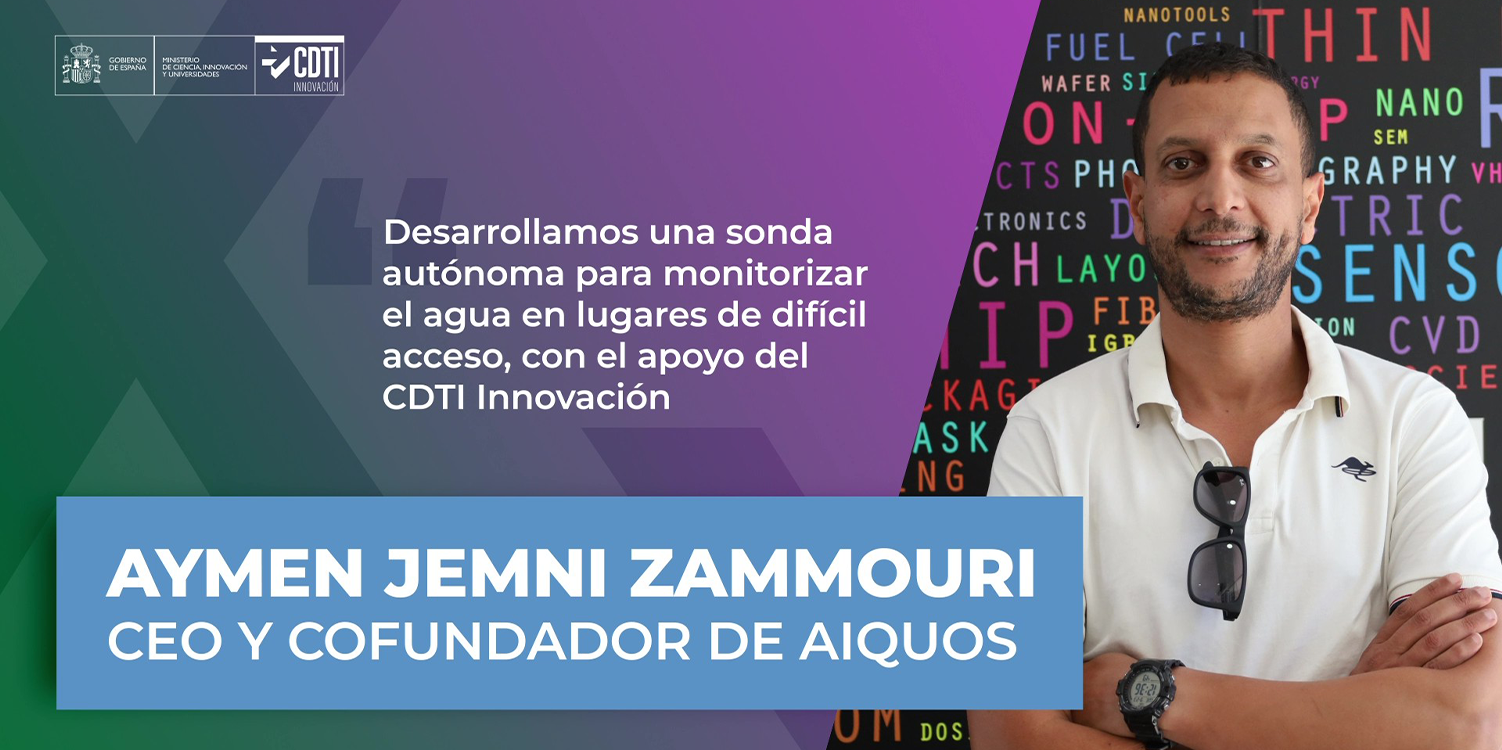
Aymen Jemni Zammouri, CEO and co-founder of AiQUOS: “We developed an autonomous probe to monitor water in places that are difficult to access, with the support of CDTI Innovation”
Measuring water quality continuously remains difficult in certain environments, where conventional equipment is often expensive, requires maintenance, and does not always allow sufficient parameters to be controlled permanently. To respond to these limitations, AiQUOS, spin-off of the CSIC and the Universität Zürich founded in 2024, develops miniaturized microchips that integrate microelectronics, sensoric electrochemistry and neuromorphic artificial intelligence to monitor this resource autonomously and predictively in areas such as aquaculture. The project is supported by CDTI Innovation through the NEOTEC program, in line with the Center’s priority to promote international technological cooperation of Spanish companies and the sustainability of sectors that use water in their processes.
The seed of AiQUOS began to be produced several years before the company saw the light. In 2013, Josep Maria Margarit, current president and CTO of the company, carried out his doctoral thesis at the Institute of Microelectronics of Barcelona (IMB-CNM) of the CSIC. His previous visit to the Institute of Neuroinformatics (INI) in Zurich, where he trained in neuromorphic engineering, led him to consider how to apply this technology to a different field, the analysis of liquids through chemical sensors.
The other piece was in the IMB-CNM itself, where Cecilia Jiménez, now AiQUOS’ chief scientific advisor, had been developing chemical microsensors made with microelectronic technology to analyze water and beverages for decades. The collaboration between the two institutes began in 2017, based on a Margarit proposal funded by a Marie Skłodowska Curie grant from the European Commission, with Aigües de Barcelona as the first industrial partner.
The objective was to transfer these scientific developments to a specific problem of water treatment. “Water is a critical medium in industry, aquaculture, agriculture and the urban cycle, but its quality is measured with expensive equipment, limited to few parameters and requiring frequent maintenance. In many environments it is not measured, or it is measured late,” explains Aymen Jemni Zammouri, co-founder and CEO of the company.
The advance of the research allowed to make the leap from the laboratory to the company. This is how AiQUOS was born in March 2024, as a spin-off of the IMB-CNM and the Institute of Neuroinformatics (INI), based in the Research Park of the UAB.
A laboratory inside the probe
AiQUOS integrates in a submersible probe a microchip that allows to analyze the water quality directly at the measuring point. “The chip works like an electronic language: dozens of microsensors that, like taste buds, detect ions and other chemical species and translate them into electrical signals,” says the company’s CEO.
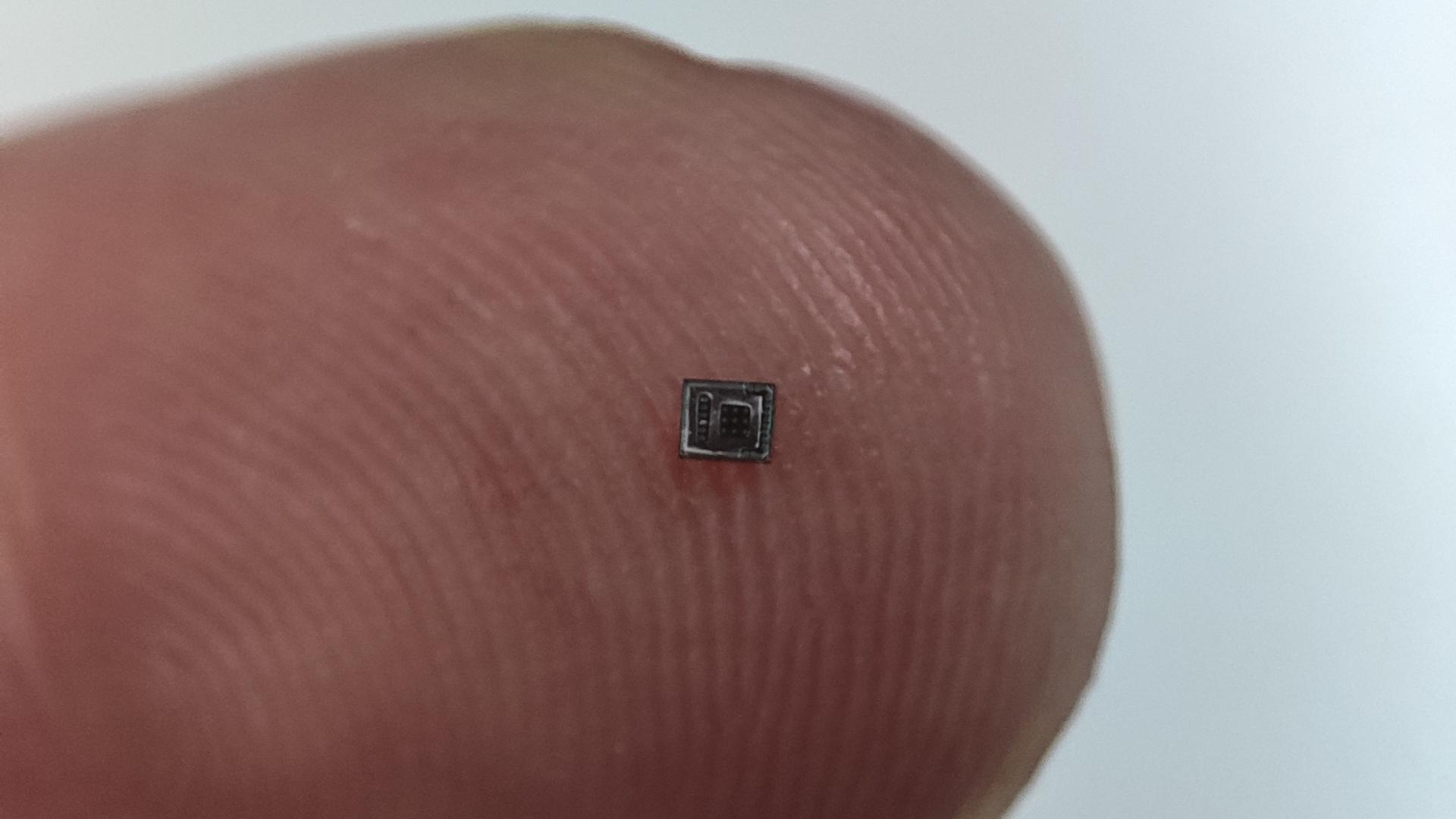 The microchip integrates microsensors and intelligent processing in millimeters
First, artificial sensory neurons filter out interferences and reduce the amount of data that needs to be transmitted. Then, a neural network inspired by the functioning of the nervous system processes those results to generate predictions and alarms, without the need to send the data to a computer or the cloud. The company calls this architecture a lab-in-a-microchip neuromorphic, because it concentrates in a very small space the capture of information and part of its analysis.
The result is a low-power device that can compensate for sensor deviations and adapt its configuration to different parameters without replacing the hardware. Currently, it allows you to directly measure eight water parameters and infer dozens more. “Imagine an analytical laboratory smaller than a grain of rice, attached to a probe submerged in water. That is the heart of AiQUOS,” he explains.
Measure without being connected
However, the challenge does not end with the installation of a sensor, since a conventional probe requires regular visits to clean and recalibrate it. This procedure is simple in accessible facilities, but it makes maintenance more expensive when the equipment is in remote locations.
The autonomy of AiQUOS allows continuous monitoring in places where such interventions are difficult, such as an open sea fish farm, a deep well or an isolated industrial plant. In addition, by processing some of the data within the device itself, the probe reduces the information it needs to transmit and can operate without relying on a permanent connection to the cloud.
For the user, this opens up the possibility of controlling the water quality for long periods and in places where it has not been possible to measure it continuously until now. “In short, it makes it possible to monitor water continuously where it matters, without the structural limitations of traditional sensoric,” he adds.
The first application comes to aquaculture
AiQUOS has chosen aquaculture as the first field of application because it meets several of the conditions in which its technology can be most useful. The quality of the water has a direct influence on the condition of the animals and, in many facilities, maintenance tasks are expensive, especially when they are in remote locations.
This need is especially visible in recirculating aquaculture systems, known as RAS, where water is reused and must be kept under permanent control. Having constant measurements makes it possible to detect changes in time and adjust the growing conditions before they affect the animals.
The pilot that AiQUOS is developing together with IRTA in the Ebro Delta allows to test the technology in real production conditions. The company is currently in the validation phase of TRL 6 and uses this environment to check how the probe responds outside the laboratory.
Beyond this field, this technology can be applied to the treatment of industrial waters, hydroponics, thermal waters, potable supply or food processes in which this resource constitutes an essential raw material. “We started with aquaculture because it allows us to validate in a technically demanding environment and with very sophisticated customers; from there, the expansion to other verticals is progressive and natural,” says the CEO.
In addition to facilitating the monitoring of water quality, early detection of changes can help adjust energy consumption, chemical treatments and feeding in aquaculture facilities, as well as anticipate situations that compromise production.
Two centers, a common goal
The technology of the Catalan company combines years of research from two specialized centers. CSIC’s IMB-CNM brings its expertise in silicon-integrated electrochemical microsensors, electronic circuits and micro and nanofabrication, while Zurich’s INI contributes to its advances in neuromorphic and sensoric bioinspired computing.
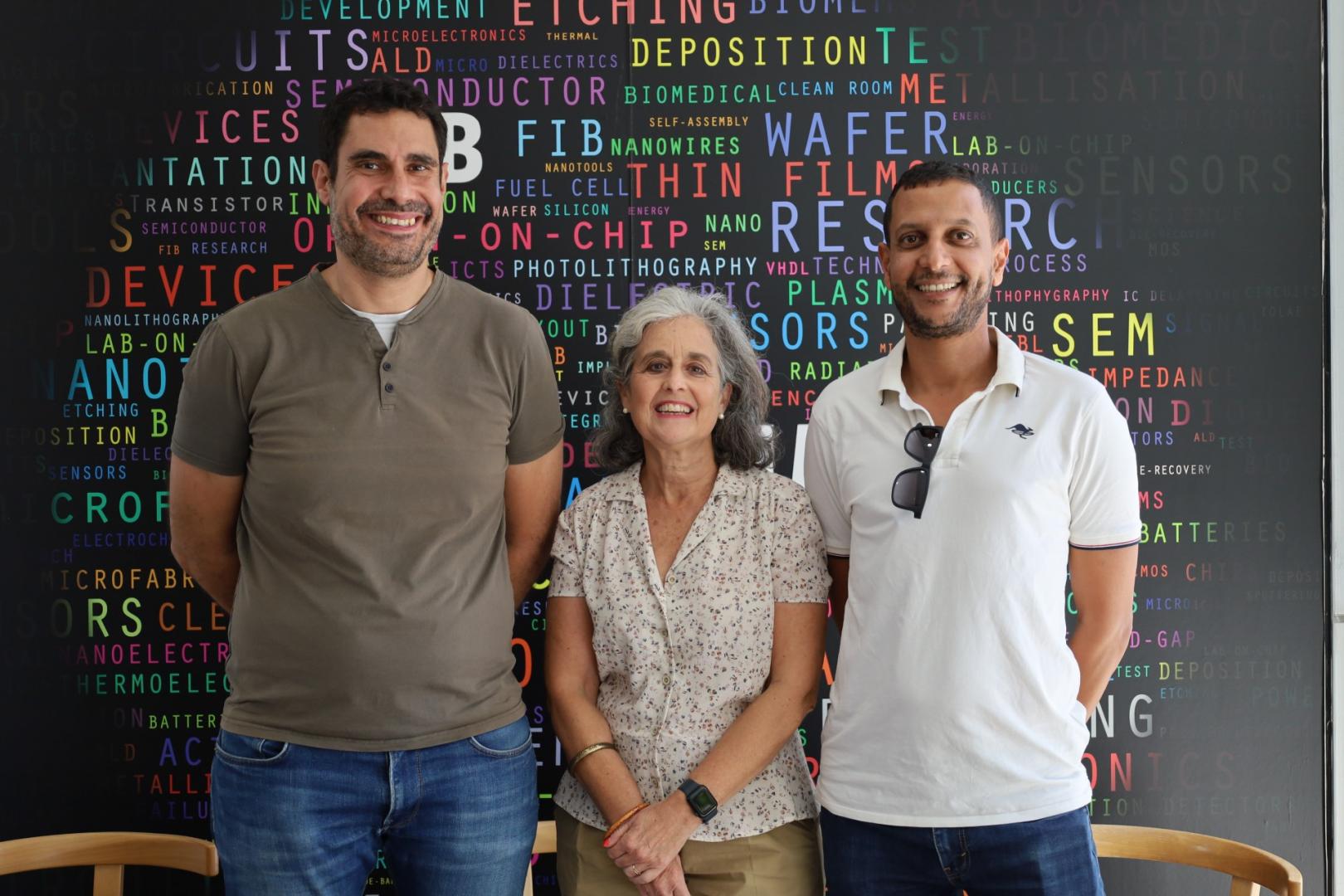 Josep Maria Margarit Taulé, Cecilia Jiménez Jorquera and Aymen Jemni Zammouri, members of the board of directors of AiQUOS
The transfer of these developments to AiQUOS has been articulated through an exclusive patent license agreement. The company has three internationalized patent families in Europe, the United States and China, and the CSIC participates in its shareholding. With this scientific and technological base, the company works to transfer the advances of research to industrial applications.
The impulse of the CDTI Innovation
Developing hardware requires long deadlines and a high investment, difficult to assume for a company that still does not generate enough volume of business. The NEOTEC program of the CDTI Innovation has allowed AiQUOS to finance this stage, consolidate the equipment, advance in the successive iterations of the chip and complete the first industrial validations.
"NEOTEC has been a key catalyst. In a deep tech project such as ours, where development cycles are long and private capital tends to arrive later, having quality public financing, that is to say non-dilutive and adapted to the R&D profile, makes the difference between being able to move forward with technology or remaining waiting," says Zammouri.
Beyond financial resources, the program also provides support that helps to accredit the project to investors, customers and industrial partners. This is highlighted by its CEO, for whom this recognition is especially relevant in a company born from public research.
Towards a new way of managing water
The next stage is to complete the validation of the technology and progressively raise its level of maturity. AiQUOS works with the goal of reaching TRL 8 in 2028, at least in two different industrial sectors, and delivering a commercial solution to the market during 2029. Aquaculture is the first step, but the company is already working to adapt its technology to other areas such as industrial treatment, precision agriculture and food processes.
In parallel, the Catalan company will have to consolidate the current pilots, develop a new generation of the chip with more integrated functions and lower energy consumption and expand its base of industrial customers. Another challenge will be to industrialize the production of the probes and reduce their unit cost.
All this is framed in a context in which water scarcity, climate change, regulation and industrial digitalization are increasing the need to know more precisely what happens in aquatic systems. “The collective challenge is to scale that model and turn public research into an exportable industrial fabric. We are convinced that the time is now.”
CDTI Innovation
The Center for Technological Development and Innovation, CDTI E.P.E. It is the innovation agency of the Ministry of Science, Innovation and Universities, whose objective is the promotion of technological innovation in the business environment. The mission of the CDTI is to ensure that the Spanish business fabric generates and transforms scientific and technical knowledge into globally competitive, sustainable and inclusive growth.
More information:
Press Office
press@cdti.es
91-581.55.00
On the Internet
Website: www.cdti.es
On Linkedin: https://www.linkedin.com/company/29815
On X: https://x.com/CDTI_innovacion
On Youtube: https://www.youtube.com/user/CDTIoficial
This content is copyright © 2026 CDTI,EPE. The use and reproduction is allowed by citing the source and digital identity of CDTI (@CDTI_innovacion).