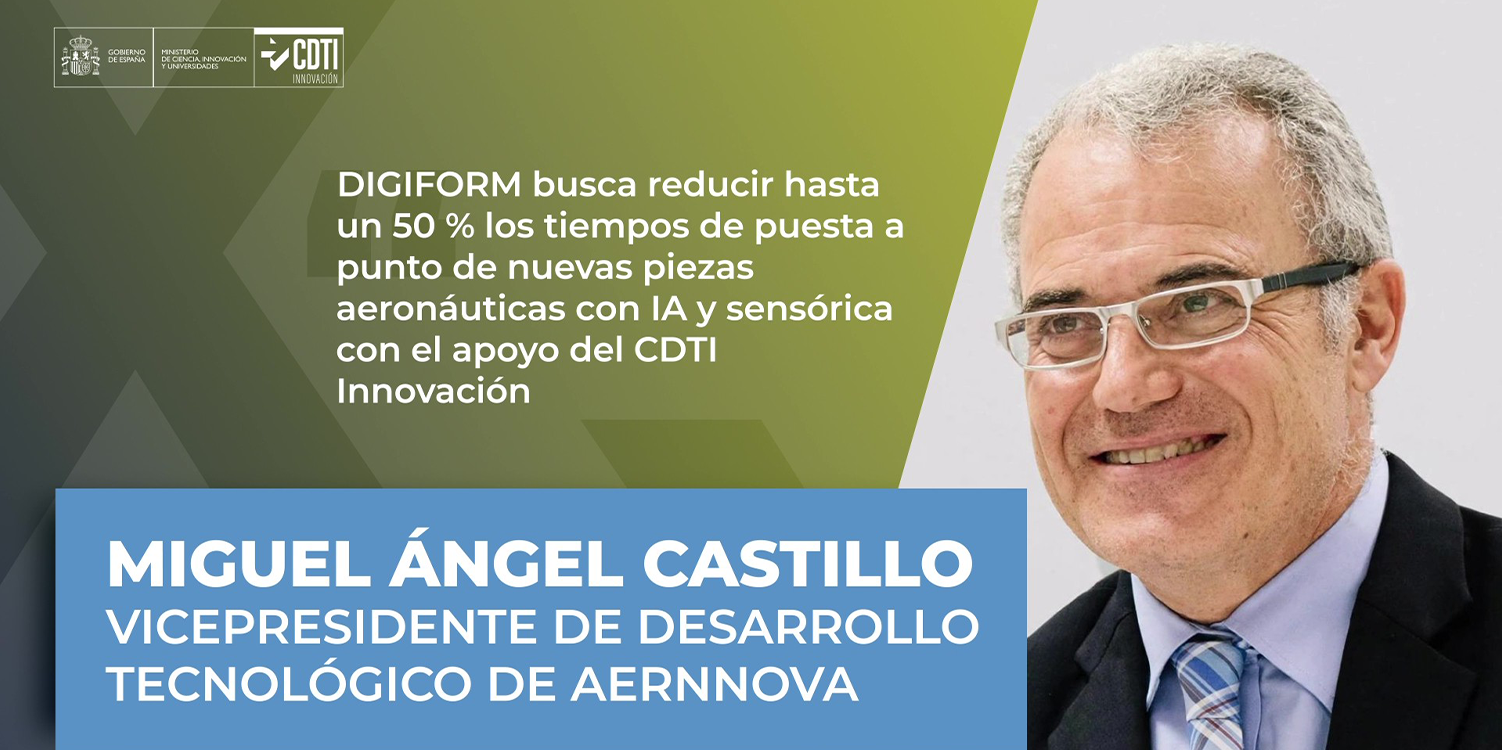
Miguel Ángel Castillo Acero, Vice President of Technological Development of Aernnova: “DIGIFORM seeks to reduce the set-up times of new aeronautical parts with AI and sensoric with the support of CDTI Innovation”
The metal components sector faces the challenge of incorporating industry 4.0 technologies that allow production in a more efficient and flexible way, without losing competitiveness against the lower costs of other countries. The DIGIFORM project, led by Intec Air, a subsidiary of Aernnova, addresses this challenge by automating and digitizing sheet metal transformation operations, combining Big Data, physical and artificial intelligence models based on data, and advanced sensoric integrated into the teams themselves. The aim is to reduce the set-up times for new products and improve quality and productivity. The initiative is supported by the CDTI Innovation through the Science and Innovation Missions line, in line with the Center's priority to promote R+D+I in traditional industrial sectors that generate qualified employment in Spain
Aeronautical manufacturing requires a combination of lightweight materials, complex geometries and particularly high levels of accuracy and traceability. In this environment, Intec Air, a company of Aernnova located in the Bay of Cadiz and specialized in the manufacturing transformation of metallic materials, especially sheet metal, for light structural components, develops its activity.
The plant works with high-performance alloys such as aluminum and titanium and with demanding processes, including chemical milling and thermal treatments. Added to these capabilities is the integral assembly of subassemblies and assemblies intended for large aeronautical manufacturers.
In recent years, this industrial experience has been accompanied by a strategy focused on innovation, with the focus on ensuring that advances do not remain in the laboratory, but are implemented in the factories. “Technological development projects are done ‘in, for, with and by’ our manufacturing companies like Intec Air,” explains Miguel Ángel Castillo Acero, Aernnova’s Vice President of Technological Development. That connection with the plants is precisely what has made it possible to pose a challenge like DIGIFORM.
Reduce the test and error in manufacturing
Many sheet metal processing processes in aeronautical manufacturing, such as forming, blasting or polishing, continue to depend on a specialized knowledge that is acquired with years of experience. The behavior of the material can vary depending on its composition, the geometry of the piece or the conditions of each operation, which requires testing and adjustments until a stable process is achieved.
DIGIFORM seeks to reduce that reliance on trial and error by transferring some of that knowledge to systems capable of working with data and responding to changes during manufacturing. The idea is to shorten the time needed to adjust a new piece and make the first units to obtain information on the behavior of the process.
Antonio Hierro, head of the DIGIFORM project at Intec Air, summarizes the industrial objective as follows: “What we are looking for is to make a qualitative leap in precision, quality and productivity when manufacturing aeronautical parts through sheet metal transformation processes.”
From data to a machine that learns
To achieve this, DIGIFORM combines sensorization, digital twins, artificial intelligence and robotic systems in the same environment. The sensors collect information on variables such as deformations, temperatures or pressures during operations, while the digital replicas reproduce the behavior of the piece and the algorithms analyze the data to detect possible deviations.
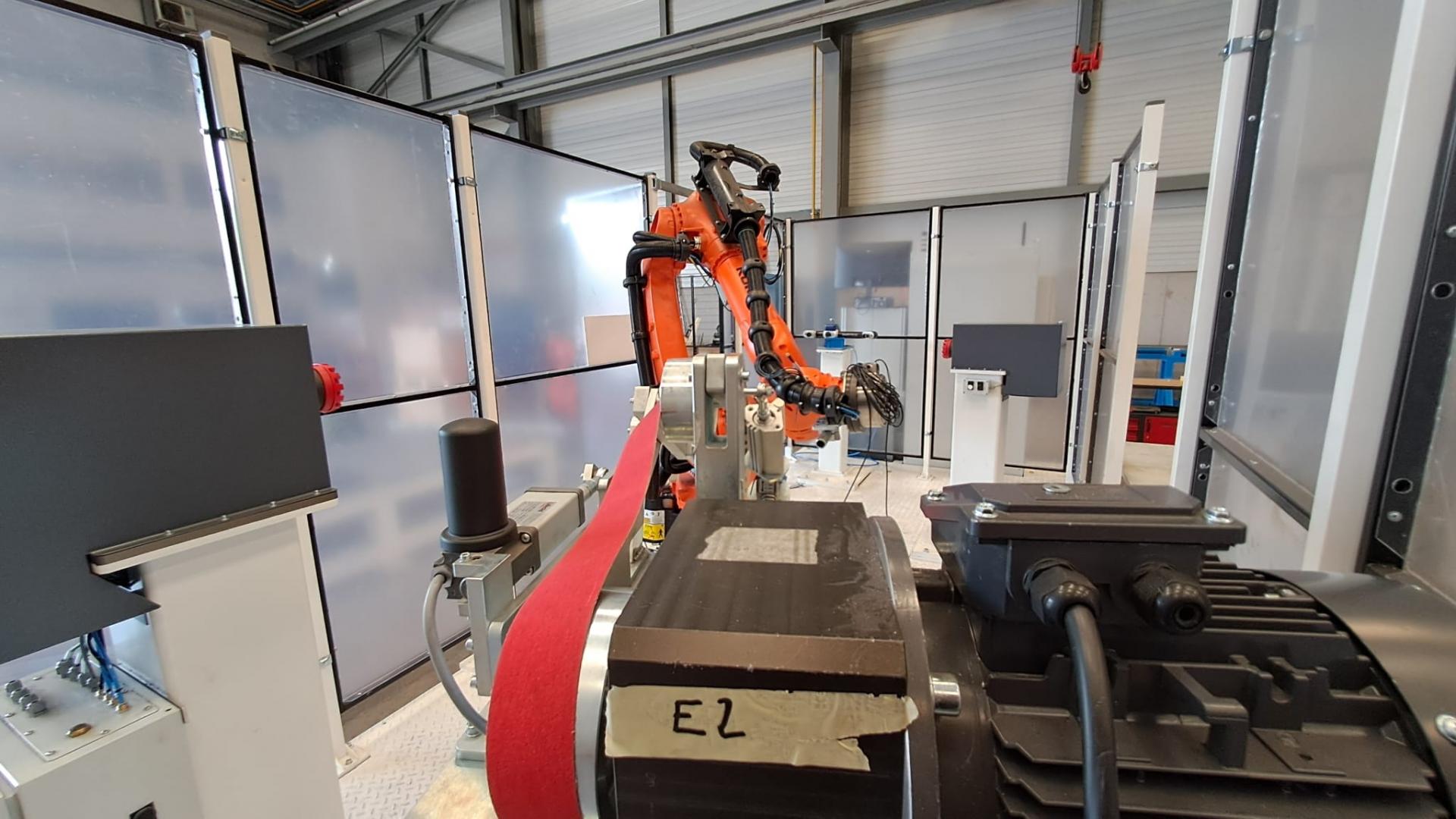 Automated industrial sanding equipment for aerospace components
The information then reaches robotic systems equipped with artificial vision and other sensors, capable of adapting certain parameters during the operation itself. This creates a real-time feedback loop that allows you to measure, interpret and correct before a defect reaches the end of the process. “In this way, traditional manufacturing methods become part of a new model of intelligent, automated and data-driven production,” says Miguel Angel Castillo.
The aim is to reduce set-up times, rejections and jobs that need to be repeated, improve the consistency of operations and make better use of high-value materials, such as titanium, while increasing the availability of equipment without the need to proportionally increase the means necessary to manufacture each new reference.
Shorten the path between design and factory
One of the areas where DIGIFORM can have the greatest impact is in industrialisation. Between the design of a part and a line prepared to produce it in a stable way, there is a phase of tests and adjustments that consumes time, materials and resources.
The digital models, the three-dimensional metrology and the data obtained from the machines will allow to anticipate part of that process and detect deviations from the first pieces. The forecasts aim to reduce set-up times and ramp-up times by 30% to 50%, accelerating the arrival at a stable production.
The knowledge generated may also become models, process rules and algorithms reusable in other parts, machines or plants. “The competitiveness of the Spanish aviation industry cannot be based solely on salary costs, but on its ability to industrialize faster, with less risk and with a high quality from the first units,” says the vice president.
New profiles for the factory
This automation process also affects the type of knowledge that is needed in the plant, since as certain manual tasks become supported by robots, sensors and analysis systems, professionals can focus on functions with greater added value. “The operator stops concentrating exclusively on the manual execution of repetitive or physically demanding tasks and goes on to perform monitoring, programming, adjustment and decision-making functions supported by data,” explains Castillo Acero.
This change also extends to areas such as quality and maintenance. Instead of only detecting defects once the part is finished, the information obtained during operations can provide clues to anticipate problems. Similarly, tracking equipment behavior can help plan interventions before a breakdown causes a shutdown.
This generates demand for profiles that combine industrial knowledge and digital skills: specialists in robotics, metrology, artificial vision, data analysis or digital twins. The technological transformation, therefore, does not eliminate the accumulated experience in manufacturing, but changes the way of using it.
An ecosystem that reaches the factory
DIGIFORM brings together six companies and two technology centers whose complementary capabilities allow us to cover everything from technological development to its application in real equipment and processes.
In addition to coordinating the project, Intec Air provides the reference industrial environment and manufacturing processes. For its part, Aerometallic Tarazona incorporates its expertise in machining and blast forming, while Aernnova Engineering Division connects design and structural calculation with production conditions.
The consortium completes the technological capabilities of MEK&BOT in automation and robotics; of Hexagon Metrology in metrology and three-dimensional capture, and of Alju Workshops in design and adaptation of machinery for surface treatments. Tekniker and Aitiip centers are added, which carry out activities related to mechatronics, modeling, digital twins, advanced data analysis and AI.
“The key to this consortium is that it covers the entire value chain,” summarizes Antonio Hierro. In addition, the validation in the plants themselves will allow to check the operation of the solutions in real production conditions and will facilitate their application in other processes and centers of Aernnova.
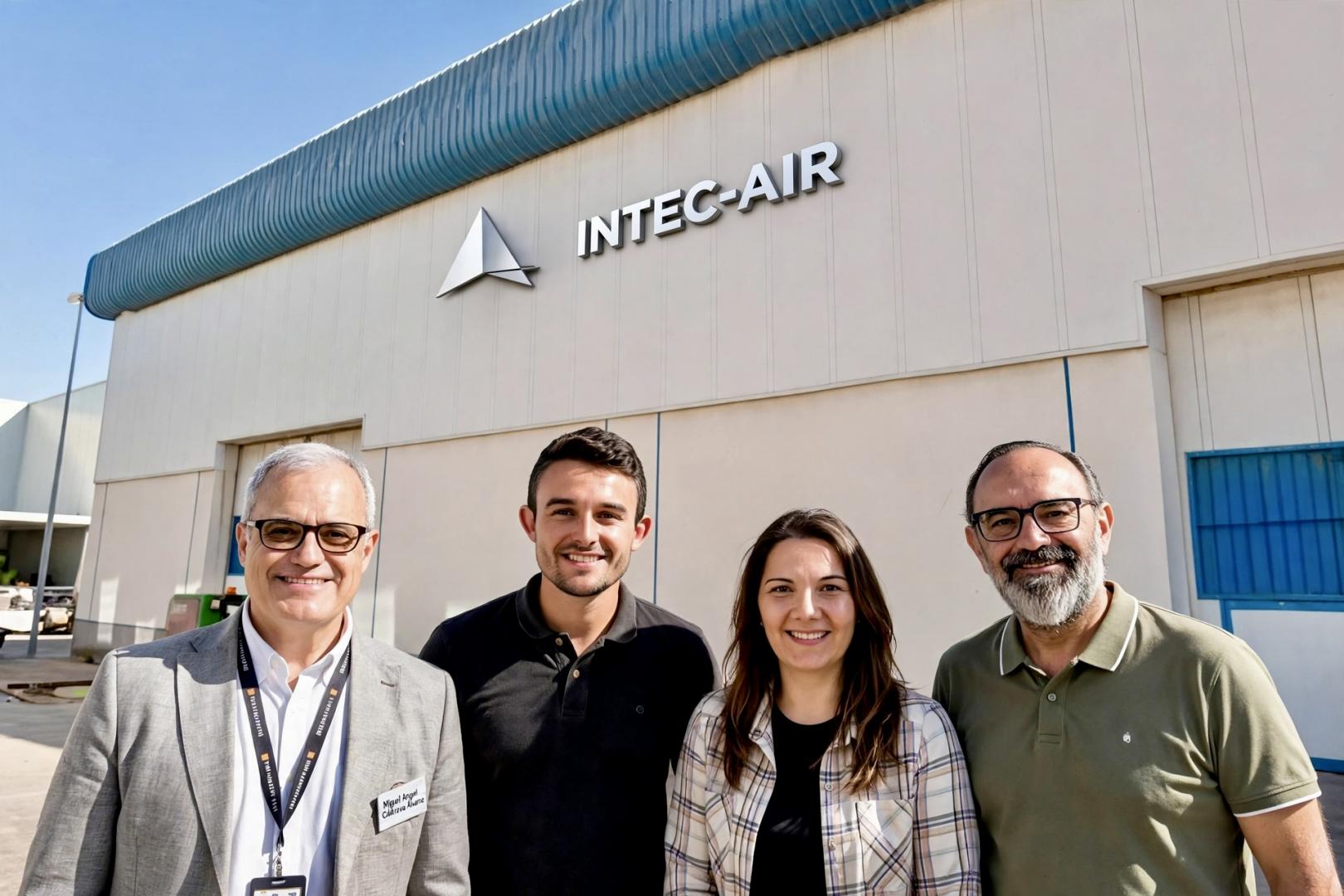 Intec Air Team Members
The digitalization of processes also connects this initiative with SDG 9, Industry, Innovation and Infrastructure, and ODD 12, Responsible Production and Consumption, by seeking more efficient manufacturing, reducing rejections and making better use of materials and resources employed.
The impulse of the CDTI Innovation
Tackling a development of this dimension involves taking technological risks and making high investments before knowing the end result. In the case of DIGIFORM, the project exceeds five million euros of total investment and approximately half of it has financial support from the CDTI within the framework of the Science and Innovation Missions aid line.
For the Cadiz subsidiary, this support allows us to address technologies that require applied research, advanced equipment and factory testing, with a significant part of the budget allocated to studies, developments, instruments and tests in the Cadiz plant. Miguel Ángel Castillo defines this support as “a strategic guarantee that allows the company to take on uncomplicated technological challenges and position ourselves from Intec Air as leaders in sheet metal forming for aeronautical components”.
From demonstration to the factory of the future
Currently, DIGIFORM is at an advanced stage of development and is scheduled to be completed in June 2027. After completing the definition of architectures and initial developments, the work now focuses on integrating and adjusting systems and contrasting digital models with test results.
The next step will be to consolidate the demonstrators in robotic cells for forming, welding and polishing processes and verify their precision, stability and reliability in industrial conditions. From there, the implementation will be progressive and will require adapting the solutions to the production rates and references of Intec Air and Aerometallic Tarazona, in addition to training the teams and checking their technical and economic viability.
In the longer term, the project seeks to connect design, manufacturing, inspection and traceability data so that systems can anticipate behaviors, recommend parameters and adapt to changes in materials, geometries or workloads. “The goal is not to automate by automating, but to gradually invest in those solutions that sustainably strengthen our industrial capacity and competitiveness,” he concludes.
CDTI Innovation
The Center for Technological Development and Innovation, CDTI E.P.E. It is the innovation agency of the Ministry of Science, Innovation and Universities, whose objective is the promotion of technological innovation in the business environment. The mission of the CDTI is to ensure that the Spanish business fabric generates and transforms scientific and technical knowledge into globally competitive, sustainable and inclusive growth.
More information:
Press Office
press@cdti.es
91-581.55.00
On the Internet
Website: www.cdti.es
On Linkedin: https://www.linkedin.com/company/29815
On X: https://x.com/CDTI_innovacion
On Youtube: https://www.youtube.com/user/CDTIoficial
This content is copyright © 2026 CDTI,EPE. The use and reproduction is allowed by citing the source and digital identity of CDTI (@CDTI_innovacion).