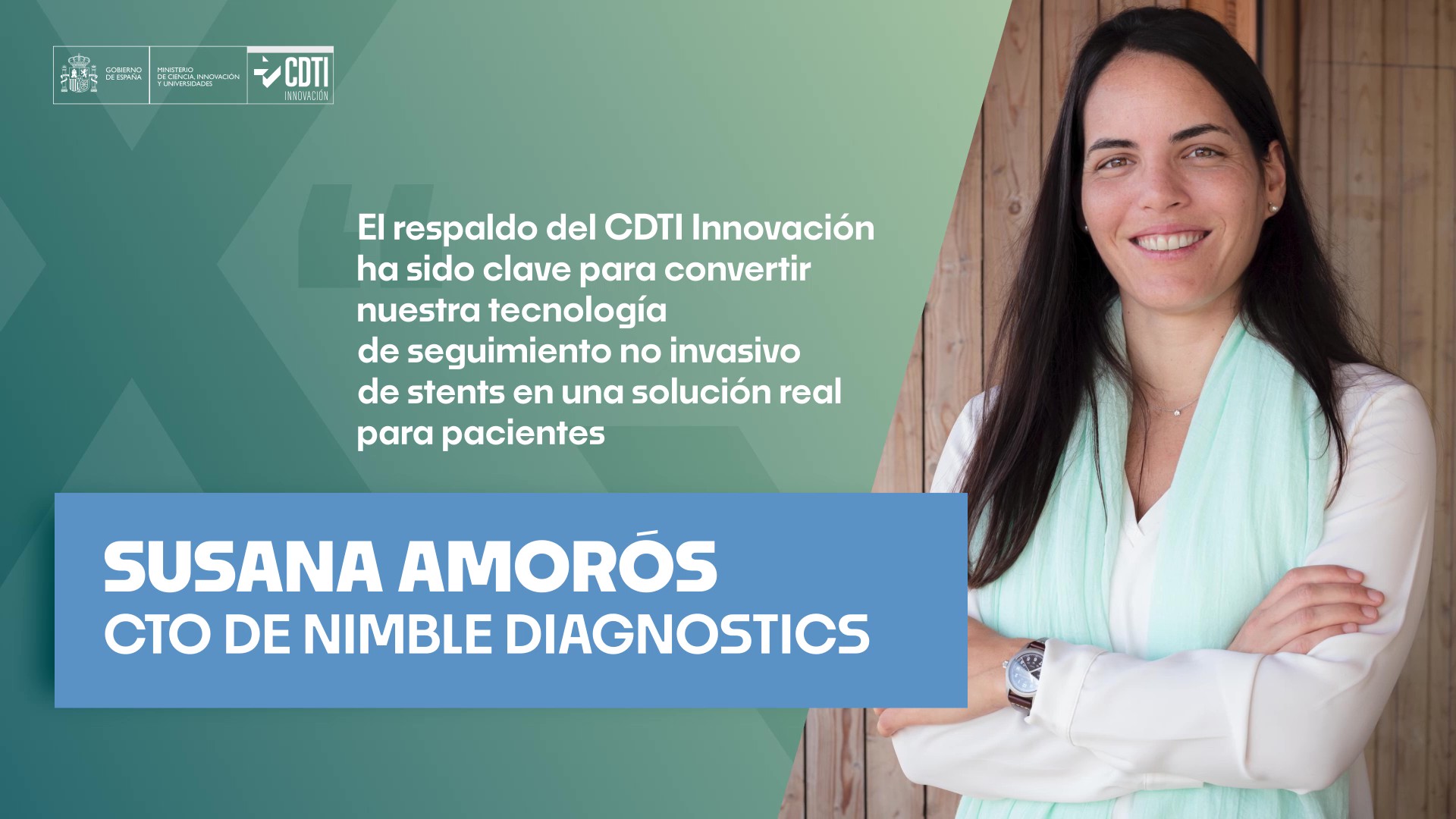
Susana Amorós, CTO of NIMBLE Diagnostics: "The support of CDTI Innovation has been key to turning our non-invasive stent tracking technology into a real solution for patients"
SoapFault exception: [ns0:Server] Error en la llamada al motor de traducción. Ha podido ser algo puntual o que el motor no esté en marcha. Contactar con el administrador del sistema. in /var/www/html/web/modules/custom/plata_service/src/Services/PlataService.php:181 Stack trace: #0 /var/www/html/web/modules/custom/plata_service/src/Services/PlataService.php(181): SoapClient->__call() #1 /var/www/html/web/modules/custom/plata_service/plata_service.module(918): Drupal\plata_service\Services\PlataService->translateHTML() #2 /var/www/html/web/modules/custom/plata_service/plata_service.module(1024): traducir_campo() #3 /var/www/html/web/modules/custom/plata_service/plata_service.module(647): translateAllLanguage() #4 [internal function]: translateNode() #5 /var/www/html/web/core/lib/Drupal/Core/Form/FormSubmitter.php(114): call_user_func_array() #6 /var/www/html/web/core/lib/Drupal/Core/Form/FormSubmitter.php(52): Drupal\Core\Form\FormSubmitter->executeSubmitHandlers() #7 /var/www/html/web/core/lib/Drupal/Core/Form/FormBuilder.php(592): Drupal\Core\Form\FormSubmitter->doSubmitForm() #8 /var/www/html/web/core/lib/Drupal/Core/Form/FormBuilder.php(320): Drupal\Core\Form\FormBuilder->processForm() #9 /var/www/html/web/core/lib/Drupal/Core/Controller/FormController.php(73): Drupal\Core\Form\FormBuilder->buildForm() #10 /var/www/html/web/core/modules/layout_builder/src/Controller/LayoutBuilderHtmlEntityFormController.php(39): Drupal\Core\Controller\FormController->getContentResult() #11 [internal function]: Drupal\layout_builder\Controller\LayoutBuilderHtmlEntityFormController->getContentResult() #12 /var/www/html/web/core/lib/Drupal/Core/EventSubscriber/EarlyRenderingControllerWrapperSubscriber.php(123): call_user_func_array() #13 /var/www/html/web/core/lib/Drupal/Core/Render/Renderer.php(564): Drupal\Core\EventSubscriber\EarlyRenderingControllerWrapperSubscriber->Drupal\Core\EventSubscriber\{closure}() #14 /var/www/html/web/core/lib/Drupal/Core/EventSubscriber/EarlyRenderingControllerWrapperSubscriber.php(124): Drupal\Core\Render\Renderer->executeInRenderContext() #15 /var/www/html/web/core/lib/Drupal/Core/EventSubscriber/EarlyRenderingControllerWrapperSubscriber.php(97): Drupal\Core\EventSubscriber\EarlyRenderingControllerWrapperSubscriber->wrapControllerExecutionInRenderContext() #16 /var/www/html/vendor/symfony/http-kernel/HttpKernel.php(169): Drupal\Core\EventSubscriber\EarlyRenderingControllerWrapperSubscriber->Drupal\Core\EventSubscriber\{closure}() #17 /var/www/html/vendor/symfony/http-kernel/HttpKernel.php(81): Symfony\Component\HttpKernel\HttpKernel->handleRaw() #18 /var/www/html/web/core/lib/Drupal/Core/StackMiddleware/Session.php(58): Symfony\Component\HttpKernel\HttpKernel->handle() #19 /var/www/html/web/core/lib/Drupal/Core/StackMiddleware/KernelPreHandle.php(48): Drupal\Core\StackMiddleware\Session->handle() #20 /var/www/html/web/core/modules/page_cache/src/StackMiddleware/PageCache.php(106): Drupal\Core\StackMiddleware\KernelPreHandle->handle() #21 /var/www/html/web/core/modules/page_cache/src/StackMiddleware/PageCache.php(85): Drupal\page_cache\StackMiddleware\PageCache->pass() #22 /var/www/html/web/core/lib/Drupal/Core/StackMiddleware/ReverseProxyMiddleware.php(48): Drupal\page_cache\StackMiddleware\PageCache->handle() #23 /var/www/html/web/core/lib/Drupal/Core/StackMiddleware/NegotiationMiddleware.php(51): Drupal\Core\StackMiddleware\ReverseProxyMiddleware->handle() #24 /var/www/html/vendor/stack/builder/src/Stack/StackedHttpKernel.php(23): Drupal\Core\StackMiddleware\NegotiationMiddleware->handle() #25 /var/www/html/web/core/lib/Drupal/Core/DrupalKernel.php(709): Stack\StackedHttpKernel->handle() #26 /var/www/html/web/index.php(19): Drupal\Core\DrupalKernel->handle() #27 {main}
Cardiovascular diseases remain among the leading causes of death worldwide. To treat many of these pathologies, the use of coronary stents has become a common practice: small metallic devices that allow the reopening of obstructed arteries and that, in practice, save millions of lives each year. However, once implanted, their follow-up remains a challenge. The tools available are not always easy to apply on a recurring basis and, in many cases, involve invasive procedures that make continuous patient monitoring difficult.
In this context, NIMBLE Diagnostics was born, a deep-tech company focused on the development of non-invasive diagnostic technologies based on electromagnetic systems. Its main line of work revolves around WAEVE, a system designed to detect and quantify alterations, such as re-obstruction or structural changes of the stent without resorting to invasive interventions.
Until now, the monitoring of stents has been fundamentally based on the appearance of symptoms and a reactive approach. In this line, NIMBLE Diagnostics proposes to move towards non-invasive and periodic monitoring that can be integrated into the usual clinical practice as part of the standard of care.
Susana Amorós, CTO of the company, explains how this technology, developed with the support of CDTI Innovation, seeks to change the way in which these patients are monitored.
 Team of NIMBLE Diagnostics, deep-tech focused on the development of non-invasive diagnostic technologies based on electromagnetic systems
From a clinical need to a technological solution
The origin of NIMBLE Diagnostics does not start from an abstract idea but from a very concrete problem in medical practice. The company was born as a spin-off of the Institut d’Investigació en Ciències de la Salut Germans Trias i Pujol (IGTP), the Universitat Politècnica de Catalunya (UPC) and the Universitat de Barcelona (UB), around a clinical need that until then did not have an adequate solution.
On the one hand, in clinical practice, the follow-up of patients with stents is still largely conditioned by the appearance of symptoms. According to Amorós: "In the absence of these symptoms, it is assumed that the evolution is favorable, which hinders the early detection of possible complications such as a second heart attack or sudden death. In addition, many patients have non-specific symptoms that require invasive tests that are not always necessary." He also adds that "the cardiologists at our hospital were faced with a lack of tools to monitor their condition systematically." Added to this and from the scientific point of view, an intuition emerged: if the stent is a metallic structure, it should interact in some way with electromagnetic signals.
To this initial collaboration was added the telecommunications engineering perspective of the UPC’s signal theory department and, what began as a hypothesis, was taking shape over time. For more than ten years, the team developed and fine-tuned the technology until it was possible to measure that type of interaction and extract useful information.
When development reached a sufficient level of maturity, the next step was natural: to turn that research into an applicable solution in the healthcare environment. This is how NIMBLE Diagnostics was born, with the aim of bringing this technology to the millions of patients who live with an implanted stent.
The result of this work is WAEVE, the system that materializes this approach.
WAEVE: interpret what happens inside without intervening
The result of this journey is WAEVE, a system based on microwave interferometry that allows the condition of the stent to be analyzed from the outside of the body.
To perform the measurement, two transducers are placed on the patient's chest, right in the area where the implant is. From there, microwaves of very low power are emitted. These waves interact with the stent and its environment, generating a signal that is then used to obtain information about its condition.
At this stage, the signal is processed. “This electromagnetic signature is analyzed by algorithms that aim to determine if there is a re-obstruction and estimate its severity,” explains the CTO, adding: "This allows the cardiologist to know the condition of the stent quickly and without the need to resort to invasive techniques."
The process can also be repeated over time with little impact on the patient, facilitating much more continuous monitoring. In this way, we move from timely testing in symptomatic patients to more regular monitoring of both symptomatic and asymptomatic patients, which opens the door to detecting problems before they translate into serious clinical episodes.
But beyond its operation, one of the key aspects of the system is its technological approach.

WAEVE device, developed by NIMBLE Diagnostics for non-invasive monitoring of stent status
A different approach to traditional techniques
Microwaves have long been explored in the medical field, but recently their use in diagnostics has been gaining interest. This is because they are not ionizing, which makes them safer for the patient. As Amorós points out well: “They allow interaction with tissues and implants without damaging them and, in addition, they can be more affordable.”
However, one of the elements that differentiates the proposal of NIMBLE Diagnostics is not only the technology, but the approach. While other systems focus on analyzing tissue properties, here the focus is on the stent itself. "Unlike other techniques that analyze tissues, NIMBLE Diagnostics focuses on the implant itself, allowing a direct and specific reading of its condition," summarizes the CTO. This approach allows you to work with more specific signals and obtain more direct information about the state of the implant.
When compared to current techniques, the difference is clear. Catheterization angiography, which remains the most common method, requires sedation, the introduction of a catheter, the use of radiation and, in addition, hospitalization of the patient. All of this makes it not viable as a frequent tracking tool. Against that, WAEVE proposes a much lighter alternative from the clinical point of view, designed precisely to be able to be used on a recurrent basis.
This approach has not only technological but also clinical implications.
anticipate rather than react
One of the main problems in patients with stents is that complications do not always give early signs. The re-obstruction can go on for months without clear symptoms and, when these appear, the problem is usually already at an advanced stage.
This is where periodic monitoring makes sense. WAEVE allows measurements to be obtained at different times in the patient’s life, without the need for an initial reference taken at the time of implantation.This allows, for example, to detect obstructions that are progressing little by little, even before they generate symptoms. Also identify cases in which the obstruction is already significant, even if the patient does not perceive it. In addition, the information obtained can help adjust treatments since not all patients evolve equally, and having more continuous data facilitates a more personalized approach.
Overall, the change is clear: “It goes from a reactive logic, based on the appearance of symptoms, to a more preventive logic,” says Amorós.
To advance this paradigm shift, the technology is currently in the clinical validation phase.
Validation in clinical environment
After more than a decade of development, the technology has reached a point where it can already be evaluated in real patients.
The current prototype, called Alpha, is being used in a first clinical study involving more than 50 patients. In this phase, the focus is both on validating the system and on continuing to improve the algorithms that interpret the signals.
The work focuses on the whole process: from pre-processing, which ensures the quality of the measurements, to the subsequent analysis, where the severity of the obstruction is estimated.
Beyond a specific result, one of the most relevant advances has been to verify that the electromagnetic signature of the stent is reproducible in the clinical environment and that, from it, information can be extracted from it.
The results obtained so far are promising. According to Amorós, "they reinforce the idea that this technology can be explored not only in this field, but also in other medical applications."

Evaluation of the condition of a stent using microwave technology, without the need for invasive procedures
The role of CDTI in the development of the project
The development of a technology like WAEVE is not immediate. It requires time, specialized knowledge and sustained investment in R&D, especially in an area where different disciplines converge. In that process, institutional support plays a key role.
In the case of NIMBLE Diagnostics, the collaboration with CDTI Innovation, through Neotec, has been one of the factors that has allowed us to move forward with greater solidity. "It has been a key support to accelerate the development of WAEVE and help transform a technology born in the field of research into a solution with business and clinical projection," explains Amorós.
This type of support is especially relevant in deep-tech projects, where development times are long and the level of technical requirement is high. "Our development requires highly specialized talent and a very intense combination of science, engineering and validation," he adds.
Beyond funding, CDTI support has also had a structural impact on the project. "It has helped to solidify development, allowing us to better structure technological progress and reinforce the transition from purely academic research to the creation of a company," says the CTO.
In this regard, he stresses that this type of initiative is key to closing the circle of innovation: "It has allowed us to take the step towards a company capable of bringing real innovation to the healthcare system."
On this basis, the company is now looking to the next stages of development.
Looking forward
In the short term, the objective is clear: to continue advancing in clinical validation and evolve the system until it becomes an integrated tool in the usual medical practice.
But the development is not limited to this application. NIMBLE Diagnostics works with the idea that this technology can be applied in other contexts, taking advantage of electromagnetic interaction with different types of implants or even with other pathologies.
If the system succeeds in consolidating itself, the potential impact can be relevant. More frequent and accessible follow-up would help to detect complications earlier, improve clinical decision-making and reduce the need for invasive procedures.
For the company, this project is also a starting point. “Our goal is to move toward a new category of microwave based non-invasive diagnostics, with applications that go beyond stents, including tracking other implantable devices such as heart valves, prostheses, or sensors.” In addition, the CTO adds:"We want to position NIMBLE Diagnostics as a key player for the next generation of personalized and preventive medicine."
At a time when medicine is moving towards more preventive and personalized models, proposals such as NIMBLE Diagnostics show how the combination of science, engineering and institutional support can translate into new tools with a direct impact on patients’ lives.
CDTI Innovation
The Center for Technological Development and Innovation, CDTI E.P.E. It is the innovation agency of the Ministry of Science, Innovation and Universities, whose objective is the promotion of technological innovation in the business environment. The mission of the CDTI is to ensure that the Spanish business fabric generates and transforms scientific and technical knowledge into globally competitive, sustainable and inclusive growth. In 2025, within the framework of the Strategic Plan 2024-2027, the CDTI provided more than 2 billion euros of support to Spanish companies and startups.
More information
Press Office
press@cdti.es
91-581.55.00
On the Internet
Website: www.cdti.es
On LinkedIn: https://www.linkedin.com/company/cdti/
On X: https://x.com/CDTI_innovacion
On YouTube: https://www.youtube.com/user/CDTIoficial
This content is copyright © 2026 CDTI, EPE. The use and reproduction is allowed by citing the source and digital identity of CDTI (@CDTI_innovacion).