Santiago Rementería, CEO of the GAIKER Foundation: “The support of CDTI Innovation and European MRR funds allows us to transfer technologies to recycle complex plastics”
With the support of the CDTI Innovation and the financing of the European funds of the Recovery and Resilience Mechanism (MRR), the GAIKER Foundation leads a consortium aimed at accelerating the transition to the circular economy in the industrial fabric. Through this initiative, the technology centre transfers advanced solutions to recover and reintroduce into production processes complex plastics and composite materials that are currently difficult to recycle.
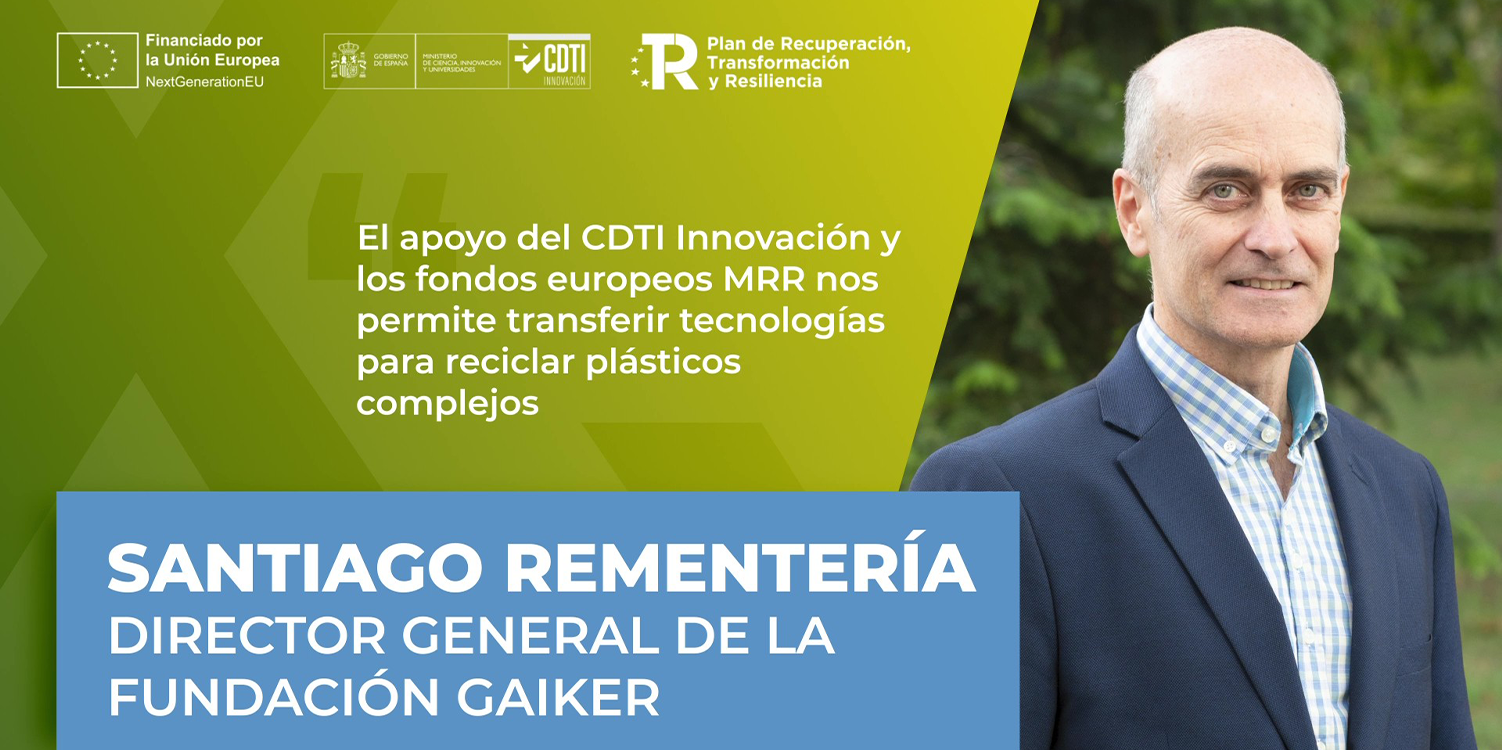
The industrial fabric faces an unprecedented transformation driven by digitalization, energy efficiency and sustainability. In this context, solving the end of life of advanced materials is no longer an option, but a requirement of the market. “The current challenge is no longer just to grow, but to develop sufficient agility to adapt to a disruptive energy and technological transition in a fragmented world,” says Santiago Rementería, CEO of GAIKER.
To respond to this challenge, this entity values its more than four decades of trajectory as a strategic partner of the industry, transforming scientific research into profitable solutions in the market. As its CEO explains, today the strategy focuses on resolving the most critical point of the process: "Plastic remains an essential material for sectors such as packaging, automotive or health, but its use is under increasing pressure due to its environmental impact, waste generation and dependence on fossil raw materials."
With this objective, GAIKER leads a CÍCLiCOM alliance, an innovation ecosystem that brings together the knowledge of the AIMPLAS and CIDAUT technology centers, the operational capacity of Valoriza Servicios Ambiental, and the sectoral impulse of the Aclima and Anarpla associations.
Solutions for materials that are difficult to recycle
CÍCLiCOM focuses on composite materials and complex plastics, widely used by the industry thanks to its performance, but whose recycling continues to pose significant difficulties. The main goal of this project is to apply already developed technologies that allow them to be recovered, treated and reintroduced into new production processes with guarantees of quality and performance.
With the support of the CDTI Innovation and the European MRR funds, this initiative seeks to connect companies and technology centers to implement solutions that allow recycling and give value to complex plastics. To achieve this, it creates an infrastructure network where companies can safely test and validate these technologies before making large investments in their production processes. “The ultimate goal is to reduce the environmental impact of these materials and, at the same time, generate new economic opportunities based on their valorisation,” explains Santiago Rementería.
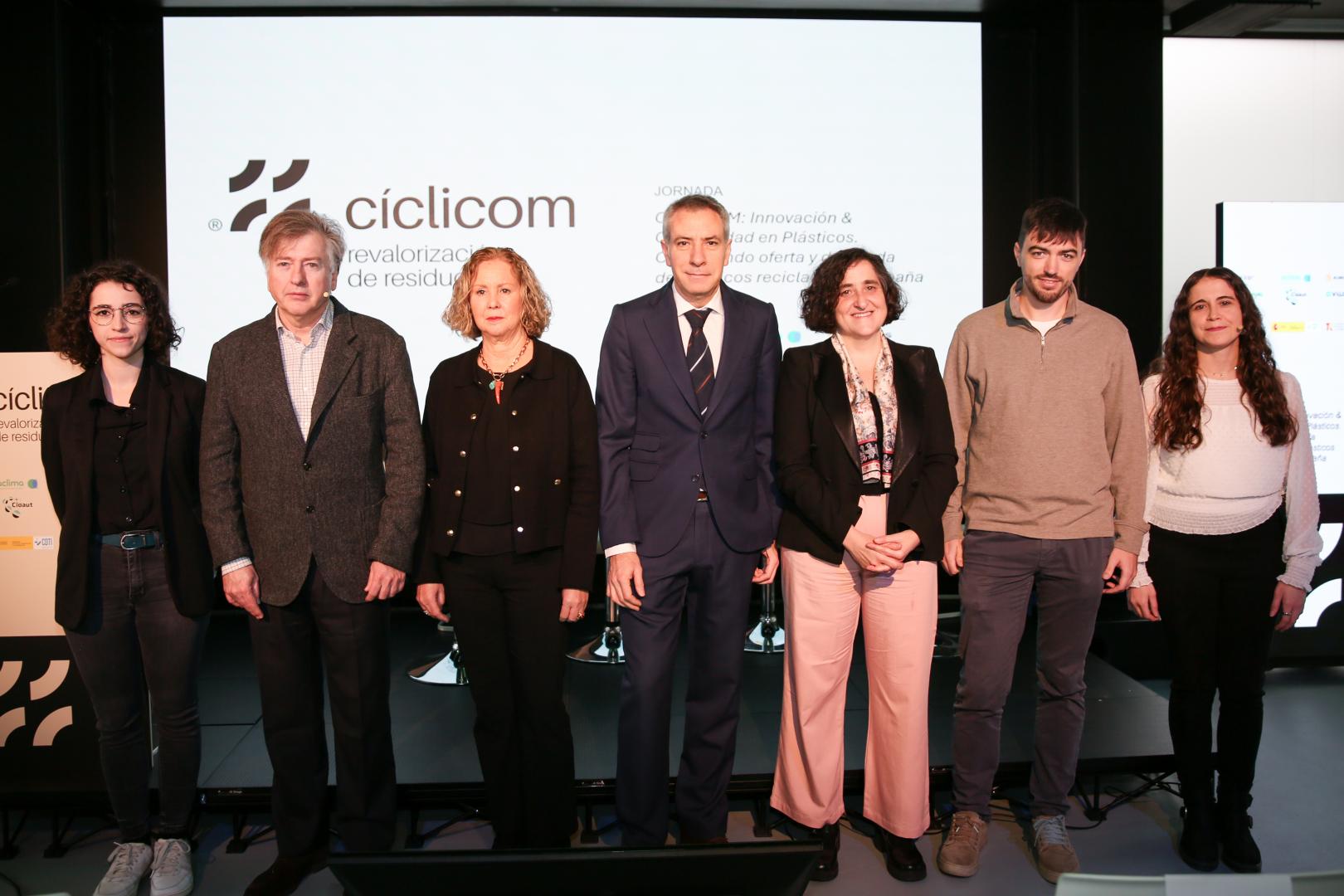 Members of the CÍCLiCOM project consortium
The real challenge for these materials to work in factories is twofold. On the one hand, the technical challenge of separating the components and ensuring their quality; on the other, the economic, since the processes must be profitable in the current production lines for the business to be viable. Breaking down these barriers is key to making the leap from the laboratory to the market, because as Santiago Rementería explains, “these technologies still need to advance in scaling, property stability, processability and industrial validation.”
From the laboratory to the industry
To bridge this gap, CÍCLiCOM values cutting-edge technical solutions previously developed in the Cervera Network, an initiative of the CDTI Innovation to promote collaboration between technology centers. Among them stand out the advanced mechanical recycling processes for construction and automotive, the classification of complex waste as wind turbine blades, and chemical recycling to obtain pure high-quality monomers.
In this process, GAIKER acts as a link between research and industry, helping companies to reduce uncertainty and risk before incorporating these technologies into their production processes. Its model is based on close collaboration with the business fabric to adapt each solution to the real needs of the industry. “We are committed from the beginning to orienting our research activity to business needs, also investing in equipment and infrastructures that facilitate technology transfer to our customers,” says the director.
Beyond technological development, CÍCLiCOM helps accelerate the transition to a more circular and sustainable industry, in line with the United Nations Sustainable Development Goals. The initiative promotes industrial innovation (SDG 9), promotes responsible production and consumption models (SDG 12) and helps reduce the environmental impact associated with the use of raw materials and waste generation (SDG 13).
The Drive for CDTI Innovation and MRR Funds
A challenge of these dimensions cannot be assumed individually. Therefore, CÍCLiCOM is articulated as a consortium of excellence that adds the capabilities of three technology centers: GAIKER, AIMPLAS and CIDAUT; the environmental services company Valoriza; and two key sectoral associations: Aclima (Cluster of Environmental Industries of the Basque Country) and Anarpla (National Association of Plastic Recyclers). “This combination allows us to approach the challenge from an integral perspective, which increases the probability of success and its continuity over time,” says Santiago Rementería.
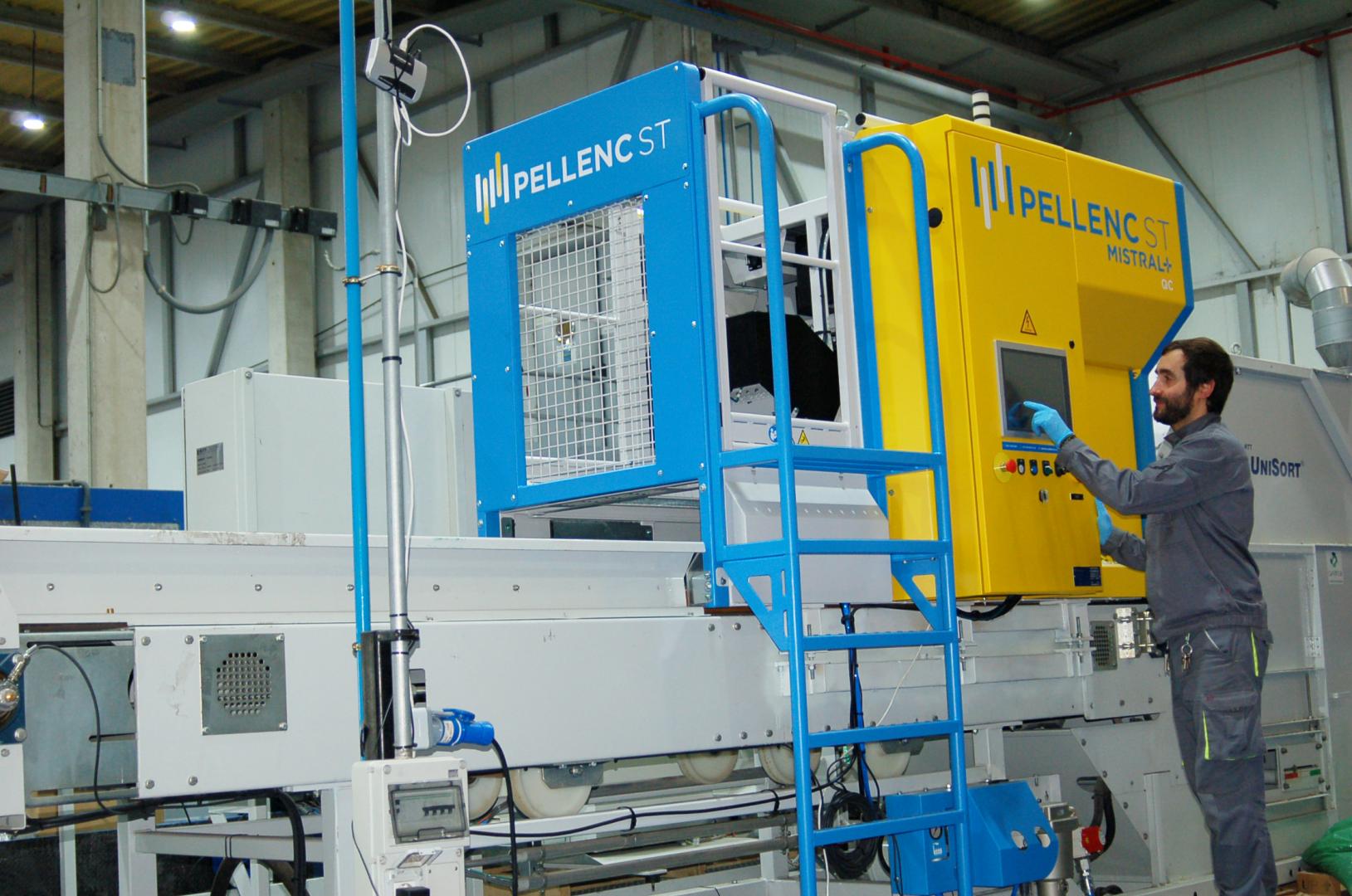 Optical sorting system for the treatment and recycling of waste
For the GAIKER Foundation, public support through the CDTI Innovation and the injection of European MRR funds has been an “indispensable driver and incentive” to accelerate technology transfer and reduce the risk of companies incorporating new industrial solutions.
"The support of the CDTI has allowed us to generate our own knowledge and facilitate the transfer of the laboratory to the market, accompanying dozens of Spanish companies in their innovation efforts, always boosting industrial competitiveness," he adds.
The challenges of the future: ecodesign and "urban mines"
With an eye on the next few years, the circular economy will force us to rethink the design of products from their origin. The challenge will no longer be only to manage the waste at the end of its useful life, but to develop materials and products designed to be reused, repaired and recycled from its conception. "Companies can no longer focus solely on managing waste at the end of the life cycle; from now on they will have to rethink their products under criteria of modularity, durability and repairability to comply with strict European regulations, as well as with the requirements of traceability and certification of recycled material content," explains the executive.
Added to this are important technological challenges. It will be necessary to scale the new materials, ensure their digital traceability, incorporate artificial intelligence into the automatic separation processes and turn waste into a strategic source of raw materials for the industry, the so-called "urban mines".
In this scenario, GAIKER aims to strengthen its role as a bridge between research and industry, making it easier for these technologies to reach the market and accelerate the transition to a more sustainable production model. "Our role will be to connect applied research, pilot capabilities and regulatory knowledge to accelerate the transition to a more circular, sustainable and competitive plastic industry," concludes Santiago Rementería.
CDTI Innovation
The Center for Technological Development and Innovation, CDTI E.P.E. It is the innovation agency of the Ministry of Science, Innovation and Universities, whose objective is the promotion of technological innovation in the business environment. The mission of the CDTI is to ensure that the Spanish business fabric generates and transforms scientific and technical knowledge into globally competitive, sustainable and inclusive growth. In 2025, within the framework of the Strategic Plan 2024-2027, the CDTI provided 2,423 million euros of support to Spanish companies and startups.
More information:
Press Office
press@cdti.es
91-581.55.00
On the Internet
Website: www.cdti.es
On Linkedin: https://www.linkedin.com/company/29815
On X: https://x.com/CDTI_innovacion
On Youtube: https://www.youtube.com/user/CDTIoficial
This content is copyright © 2026 CDTI,EPE. The use and reproduction is allowed by citing the source and digital identity of CDTI (@CDTI_innovacion).