Luis Javier Fernández Villalobos, sole administrator of Agrofervi: the CDTI Innovation and the FEDER funds have made it easier for us to develop APINUT, which seeks sustainable uses for the walnut shell
Making better use of available resources and reducing the environmental impact of agricultural activity are two of the sector’s great challenges. In this context, Agrofervi Farms develops the APINUT project, an initiative that investigates new applications for the walnut pellet within the farm itself. The proposal is supported by CDTI Innovation and the cofinancing of European ERDF funds
In the agri-food sector, innovation is not always born in laboratories far from the land. It often arises directly in the exploitation, when the daily experience is combined with technical observation and the will to improve the productive processes. This is the case of Agrofervi Exploaciones Agrícola, a company from Extremadura that has promoted the APINUT project with a clear objective: to transform the walnut pellet, traditionally considered a waste, into a resource with agricultural and environmental value.
Luis Javier Fernández Villalobos, sole administrator of the company, explains that the initiative responds to a logic very present in modern agriculture: making the most of the available resources and reducing the environmental impact of productive activity. “We try to extract productivity from waste that is not used at all,” he says. This approach has led to an R&D project that seeks the integral use of walnut by-products, opening up new circular economy routes in the agricultural sector.
Family business with an innovative vocation
Agrofervi has roots deeply linked to the family’s agricultural tradition. Its origin dates back to 1991, when it was born as an Agrarian Society of Transformation promoted by Cristóbal Fernández Franganillo and Manuel Miguel Villalobos Amador, two farmers with concerns to improve their farms and adapt to the changes of the sector. In 2007, the organization was transformed into a limited society to face new challenges and expand its projection.
Currently, the company is managed by the brothers Jesús María Fernández Villalobos, agricultural engineer, and Luis Javier Fernández Villalobos, agricultural technical engineer. With a team of 14 workers, it develops activity in different crops: industrial tomato —in collaboration with the Conesa group—, olive for oil, cereals and nuts such as nuts, almonds and pistachios, which it also processes in its own facilities.
Although it does not have a formal R&D department, innovation is part of its day-to-day operation. “We are continuously doing R&D,” explains Fernández Villalobos, who is responsible for innovation projects with the technical support of his brother. Approximately 6% of the turnover goes to research and development, which has allowed advances such as the production of rice through drip irrigation and root ball transplantation to reduce water consumption, the development of a fungicide from cheese residues or the adaptation of olive varieties to their productive environment.
From waste to resource
The APINUT project is born directly from the productive practice of the company. During the processing of the walnut, a significant amount of plant material —the pellet— is generated, which traditionally lacks use. For Agrofervi, this waste raised a double question: how to manage it and whether it could be transformed into a useful resource.
The company decided to analyze its composition and detected its potential. “We did a preliminary analysis to see the composition of it and that’s when we realized that we could give it another use,” explains Fernández Villalobos.
As with many applied innovation projects in the agricultural field, the initiative arises from a specific need for the production process. “When we have an inconvenience such as the walnut peeling residue, we try to find a solution,” he says. In this way, the financial support of CDTI Innovation and the European ERDF funds has been decisive, providing “the necessary liquidity for the development of the project” and helping to face the costs associated with research.
The project is developed in collaboration with the Agri-Food Technology Center of Extremadura (CTAEX), whose participation has been key. According to the head of Agrofervi, the center brings “experience and agility in agricultural research and development”, in addition to a highly qualified and nationally recognized technical team.
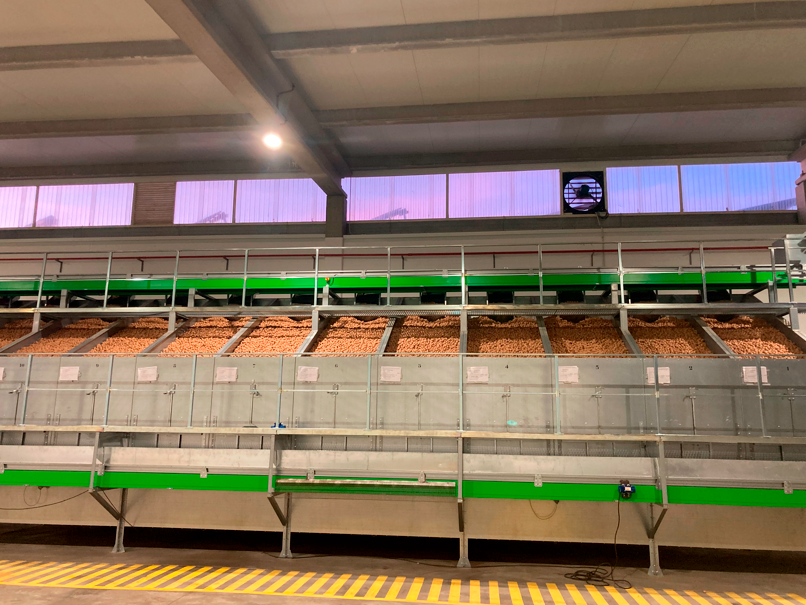
Agrofervi facilities related to the production of nuts
Agricultural applications and biological control
One of the main research areas of the project is the use of pelon as a bionematicide. Nematodes (worms) represent a relevant threat to numerous horticultural crops and their control has become more complex by the progressive removal of synthetic chemicals.
In this context, the development of natural solutions acquires special relevance. “The main advantage as a bionematicide is that most synthetic chemicals for agricultural use are being removed from the market,” explains Fernández Villalobos. In addition, its application could be especially useful in organic farming, which has fewer tools to combat these pests: “It’s important for organic farming that it has no way of combating nematodes in horticulture.”
The approach responds to an extended logic in modern agrarian management: “Every by-product in agriculture is trying to get added value or productive environmental management.”
Circular economy within the farm
The project also explores the use of dehydrated pellet as a substrate for horticultural seedlings and as an adsorbent material in the treatment of washing waters, two lines that seek to close the production cycle and reduce dependence on external inputs.
Currently, the production of seedlings with root ball uses materials such as coconut fiber, peat or vermiculite, which must be purchased on the market. Replacing part of these components with treated pellets would mean economic savings and a breakthrough in sustainability. “If with the use of dehydrated hair we can save part of the product we are saving money, and if it has nematicidal effect it is a great advance.”
The reuse of treated water would also contribute to improving resource efficiency. “For irrigation of the farm itself we are saving on natural resources as important as water.”
If the system proves its viability, the environmental impact would be significant. “If the use of the pellet is viable, we have a very important impact with respect to the residue,” he says.
Challenges and continuous learning
As with any applied innovation project, technical development poses challenges. The main one is related to the drying of the pellet, a process necessary for its storage and subsequent use.
Currently the material is spread on esplanades to favor its natural dehydration, although climatic conditions can hinder the process. “The most important challenge is the management of the hair to dry it,” explains Fernández Villalobos. Part of the material is also stored in palots inside cooling chambers, while the company studies the possibility of building a specific dryer that facilitates its management in the future.
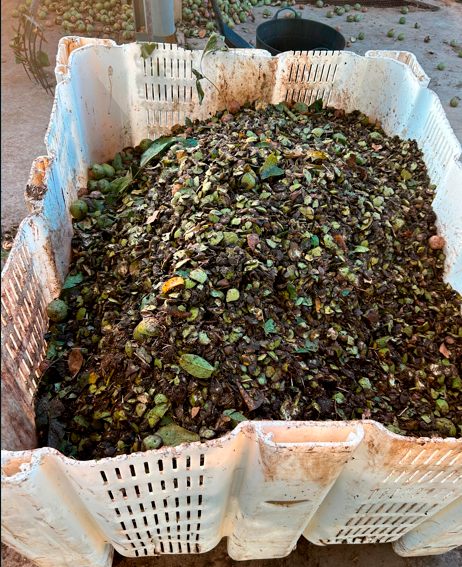
Storage of waste from nuts
Innovation, competitiveness and projection
The project not only responds to a specific technical challenge, but also strengthens the company’s strategy towards more efficient and sustainable production models. In addition, the institutional support linked to the development of the project has had effects beyond the strictly financial.
“It has had a quite significant impact on the financing of the project, because it helps us with the expenses caused in research and development,” explains Fernández Villalobos. But it also highlights the reputational value: “The support of CDTI Innovation in trying to sell our products is very important. We value the company in a different way.”
From his perspective, this type of financing promotes the modernization of the productive fabric. “If a company does not innovate in its production process, it tends to become obsolete.” Innovation generates internal improvements that translate into economic growth, stability and environmental development. “Any change in a company benefits its workers as well.”
Beyond the walnut
The scope of the project could be extended to other agricultural by-products. Agrofervi is already studying to apply the acquired knowledge to the use of pistachio skin, which could have similar properties.
“We believe that pistachio skin can have a similar use and if the results of the project are as expected we will continue with the pistachio skin, it is the next challenge”, says Fernández Villalobos.
The company’s experience shows how innovation can arise directly from agricultural practice when the observation of a problem is combined with technical knowledge, scientific collaboration and research support.
The APINUT project not only seeks to transform a waste into a resource, but also to move towards a more efficient, sustainable and circular production model, demonstrating that the countryside remains a privileged space to generate solutions with economic, environmental and social impact.
CDTI Innovation
The Center for Technological Development and Innovation, CDTI E.P.E. It is the innovation agency of the Ministry of Science, Innovation and Universities, whose objective is the promotion of technological innovation in the business environment. The mission of the CDTI is to ensure that the Spanish business fabric generates and transforms scientific and technical knowledge into globally competitive, sustainable and inclusive growth. In 2024, within the framework of a new strategic plan, the CDTI provided more than 2.3 billion euros of support to Spanish companies and startups.
More information:
Press Office
press@cdti.es
91-581.55.00
On the Internet
Website: www.cdti.es
On Linkedin: https://www.linkedin.com/company/29815
On X: https://twitter.com/CDTI_innovacion
On Youtube: https://www.youtube.com/user/CDTIoficial
This content is copyright © 2026 CDTI,EPE. The use and reproduction is allowed by citing the source and digital identity of CDTI (@CDTI_innovacion).