José A. Otero, technical director of the IR Maxoinversiones project on green hydrogen in the Canary Islands: “The support of CDTI Innovation and FEDER funds is essential for innovative projects in renewable energies”
IR Maxoinversiones promotes a sustainable green hydrogen production project that integrates the entire value chain with the aim of turning the island into a reference for clean mobility. A pioneering initiative in the Canary Islands, supported by the CDTI Innovation and the European ERDF funds, which demonstrates how innovation can redefine the energy model in island territories and open up new opportunities for the transition to renewable fuels
The history of IR Maxoinversiones is that of a strategic evolution that responds to both market opportunities and a vision of the future. Its origin goes back to the old Trans Fuerttruck SLU, a transport company that would end up being absorbed by the current society. It was then that a national oil company, interested in establishing itself in Fuerteventura, contacted the company to guarantee the transport of fuel on the island.
“That initial proposal generated an absolute dependence on the carrier and finally the oil company proposed us to become its franchisee on the island, dedicating ourselves directly to the marketing of fuel,” they explain from the company. That turn was the trigger for the creation of IR Maxoinversiones SLU, which today operates service stations, carries out fuel transportation and supplies bulk by truck tub.
The company, whose sole partner is IELG Holding SLU, currently has 79 employees —including the entrepreneur himself—, nine people in central services and an R+D+I department composed of two professionals. It operates exclusively in Spain, although it has begun its expansion towards the Peninsula after consolidating in the Canary Islands. Its main customers are transport companies, construction companies and industrial laundries.
But the true strategic leap of the company is not in territorial expansion, but in the transformation of its energy model. “Our goal is to consolidate a transition from the exclusive commercialization of fossil fuels to the production and commercialization of renewable fuels,” says IR Maxoinversiones.
Fuerteventura, a real laboratory for green hydrogen
For IR Maxoinversiones, Fuerteventura meets unique conditions. “We believe that the island is the perfect laboratory to implement this technology,” says José A. Otero, technical director and project manager. It is a contained territory where “all the expected production can be commercialized and supplied with only three dispensing points, being enough to cover the surface of the entire island”.
Added to this is a key factor: the climate. “We have up to 9 or 10 hours of sunshine a day on average, which allows us to power the photovoltaic installation associated with the hydrogen production center.” This combination of territorial scale and solar resource makes the island an ideal environment for testing an integral model.
The bet is not experimental in the theoretical sense, but fully operational. “By doing so in a content island environment, we can deploy, adjust and validate the entire model more quickly and with a direct impact on local mobility,” explains Otero. IR Maxoinversiones also has a structural advantage: its previous experience in energy supply and its direct relationship with the end customer.
The conviction of the company is clear: “We believe that green hydrogen is the future of mobility, a clean and transparent energy with the consumer.”
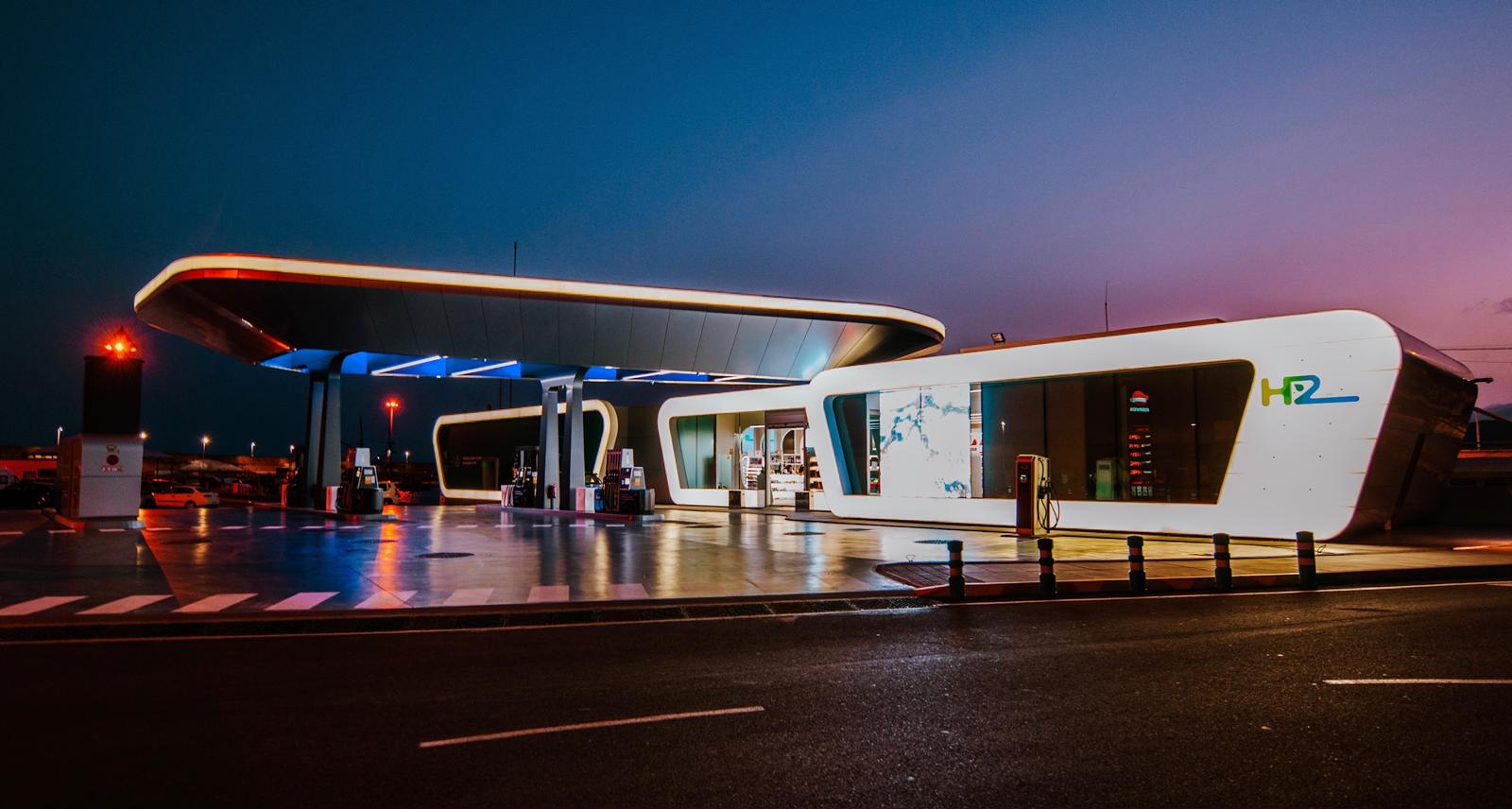 Gas station adapted to serve hydrogen vehicles
Production, distribution and marketing
One of the distinctive features of the project is that it covers the entire hydrogen value chain: production, storage, transport and supply in hydropower plants. “The main value here is the circular economy. We have a project that ranges from the production to the commercialization of hydrogen, without any emission of CO₂ to the environment throughout this process,” says Otero.
This integration reduces external dependencies and strengthens the security of supply in a territory with its own logistical constraints. “We don’t depend on other companies adopting these technologies early; we can teach a complete project where other firms can already see that it’s a model that works.”
The company does not start from zero. It already has its own transport fleet, sales centers and a consolidated portfolio of customers. “The project is 100% complementary to our previous activities,” he stresses. This operational continuity facilitates the implementation of hydrogen as a new line of business without internal fractures.
In addition, the company has accumulated previous experience in energy self-sufficiency, including the installation of a self-sufficient whirlpool with batteries and hydrogen batteries, as well as renewable generation systems in its network of service stations.
Energy self-sufficiency as an essential condition
The production plant will operate with fully renewable energy thanks to its own photovoltaic installation. For Otero, this item is not optional: “Without energy self-sufficiency, this project would be meaningless.”
The design contemplates a progressive scalability. As hydrogen production increases, the solar installation can be sized to absorb greater energy demand. In this way, the consistency of the “zero emissions” model from generation to final consumption is maintained.
“It allows us to maintain a clear approach to real and transparent sustainability with the consumer,” says Otero. In addition, the renewable base facilitates replicating the concept in other territories, adapting the photovoltaic capacity to the growth of the project.
Learning while moving forward
Developing green hydrogen in the Canary Islands means overcoming specific challenges. The main one, according to Otero, has been the search for qualified talent and the transfer of cutting-edge technologies to Fuerteventura. “We have had difficulties mainly due to bureaucratic issues in the customs services, where there is a lot of ignorance about these new technologies.”
Nor has legislation always evolved at the same pace as innovation. “In some cases we have detected a discrimination at the bureaucratic-fiscal level of hydrogen cars compared to other conventional electric models.”
As pioneers, they have taken on an additional role: that of technical interlocutors with the administration. “We are advancing the project and at the same time advising local and regional institutions to address this lack of knowledge.” This process, although complex, is helping to generate a base of experience that will facilitate future initiatives in the archipelago.
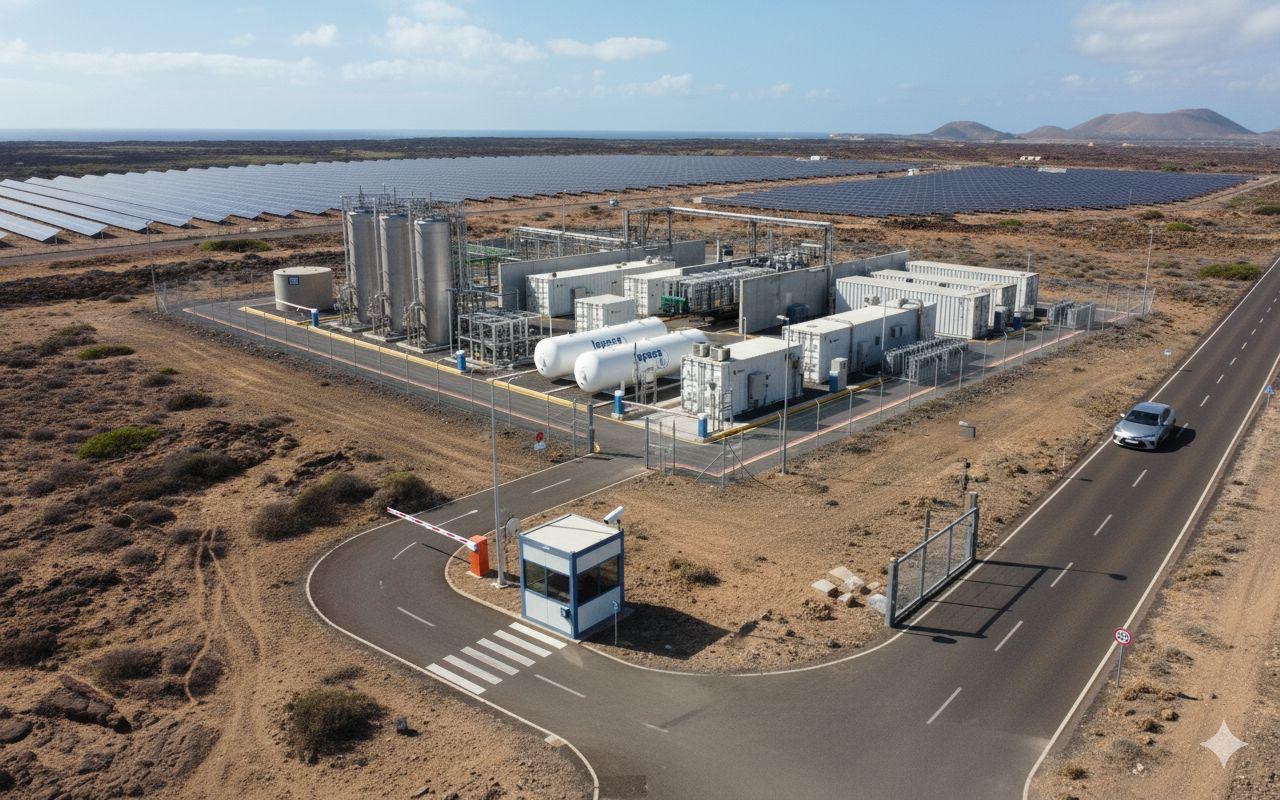
Future sustainable hydrogen production centre
Diversification and Fair Transition
The project also includes, in the medium term, the production of biodiesel. For IR Maxoinversiones, the energy transition should not be exclusive. “We don’t want to impose any technology, but to bring all possible sustainable options to Fuerteventura and its people.”
Biodiesel is considered as a complementary tool that facilitates a fair transition in sectors where electrification or hydrogen may take longer to be implemented. In addition, hydrogen can act as a lever to enable new renewable fuels.
This strategic vision is part of a sustained commitment to innovation: the company allocates approximately 1% of its turnover to R&D, a significant figure for a company from the traditional field of fuels.
In this context, institutional support has been decisive in order to sustain a project of this magnitude. “It has been an important impulse to be able to continue a project in which it is difficult to find bank financing, since the entities are reluctant to finance any investment that does not provide immediate returns,” says Otero.
For the technical director, the support of the CDTI Innovation and the European ERDF funds is strategic: “We value very positively the activity developed by the CDTI as an essential aid so that Spanish companies can invest in projects with a high R+D+i component, especially in the field of renewable energies.”
In a geopolitical context where energy autonomy has become a European priority, this type of impulse becomes even more relevant. “Renewable energies have become a strategic objective for both Spain and the European Union as a whole,” he stresses.
An exportable model from the Canary Islands
Beyond the local impact, IR Maxoinversiones hopes that its project will serve as a reference for other island territories. “If we are able to do it in Fuerteventura, with all the logistical complications that this entails, we will be an example for other territories to adopt hydrogen.”
The key is to demonstrate that the complete model—renewable production, logistics integration, and final supply—works in real conditions. Accumulated technical, regulatory and operational learning could become a practical guide for other islands.
With this initiative, the company not only redefines its business identity, but also projects from the Canary Islands a vision of sustainable mobility based on self-sufficiency, the circular economy and the integration of the entire value chain. Green hydrogen is not only a new line of business: it is the axis of a transformation that aspires to position the island as a reference for energy innovation in the European insular area. This change is materialized in the project of sustainable hydrogen production in the Canary Islands, an initiative that aims to turn Fuerteventura into an island reference of clean mobility.
CDTI Innovation
The Center for Technological Development and Innovation, CDTI E.P.E. It is the innovation agency of the Ministry of Science, Innovation and Universities, whose objective is the promotion of technological innovation in the business environment. The mission of the CDTI is to ensure that the Spanish business fabric generates and transforms scientific and technical knowledge into globally competitive, sustainable and inclusive growth. In 2024, within the framework of a new strategic plan, the CDTI provided more than 2.3 billion euros of support to Spanish companies and startups.
More information:
Press Office
press@cdti.es
91-581.55.00
On the Internet
Website: www.cdti.es
On Linkedin: https://www.linkedin.com/company/29815
On X: https://twitter.com/CDTI_innovacion
On Youtube: https://www.youtube.com/user/CDTIoficial
This content is copyright © 2026 CDTI,EPE. The use and reproduction is allowed by citing the source and digital identity of CDTI (@CDTI_innovacion).