Joachim Janssen, CEO of IAPsolutions: “The CDTI Innovation and FEDER funds have boosted our international thermal desalination project for clean water generation”
Ensuring sustainable access to drinking water is one of the great global challenges of the 21st century. With the support of CDTI Innovation and the European funds FEDER, the Spanish technology company IAPsolutions leads an R&D project that applies artificial intelligence, advanced control and renewable energies to the development of an intelligent thermal desalination system, designed to improve access to water in rural environments and with limited infrastructures
Guaranteeing access to drinking water in a context of climate change, water stress and territorial inequality has become one of the great global challenges. In this scenario, technological innovation emerges as a key lever to offer sustainable, efficient and adapted solutions to environments with limited infrastructures. With this vocation was born the Intelligent Thermal Desalination System for the Generation of Clean Water, an R&D project promoted by IAPsolutions and supported by the CDTI Innovation and European funds FEDER, which applies advanced control technologies, artificial intelligence and renewable energies to the purification of water in rural areas.
At the head of this initiative is Joachim Janssen, CEO of IAPsolutions, a Spanish technology company with more than two decades of experience in the development of advanced software for the intelligent management of critical infrastructures, which now transfers that knowledge to the field of water with a clear social, environmental and international approach.
Fundada en 1997 bajo la denominación Dynamic Consulting International Telecommunications Spain, S.L., IAPsolutions was born with the aim of developing advanced software solutions for the telecommunications sector and complex infrastructure management. Since its inception, the company has opted for innovation as a strategic axis, a decision that has allowed it to consolidate itself as a technological supplier of large operators, infrastructure companies and public administrations, both in Spain —with a prominent presence among IBEX-35 companies— and in international markets.
With a team of between 25 and 35 highly qualified professionals, a significant part of them dedicated to the R&D department, the company can spend up to 20% of its turnover on research and development, integrating technologies such as artificial intelligence, edge computing and the Internet of Things into its own platforms such as its distributed architecture of FieldAgents. “Our expertise in software and advanced control systems is applicable to any environment where there are critical processes that need to be monitored, automated and optimized,” explains Janssen.
This transversal approach led the company to explore new areas linked to sustainability and efficiency in the use of resources, such as energy, smart cities or intelligent water management. “Purification and desalination pose precisely these kinds of challenges. Applying our knowledge to this area responds to a technology transfer strategy aimed at sustainability and social impact,” he stresses.
A modular system, autonomous and designed for rural environments
The project developed by IAPsolutions is structured around a modular and scalable system of thermal purification and desalination, based on evaporation and condensation processes, and powered entirely by photovoltaic energy. Its design allows it to operate in environments without stable access to the electricity network and with limited technical resources, a fundamental characteristic for its implementation in rural areas or regions with water stress.
The solution incorporates water quality sensors, intelligent control and AI algorithms, with a clear focus on ease of maintenance, sustainability and operational autonomy. “Although the physical principle of the system is simple, artificial intelligence allows to reduce unnecessary consumption, optimize maintenance and adapt the operation to different operating conditions,” says the CEO of IAPsolutions.
One of the differential elements of the project is that the AI models are embedded in the system itself, which allows to operate locally, with low energy consumption and without dependence on external connectivity. “This is critical in rural environments, where stable digital infrastructure is not always available,” says Janssen.

First prototype of the project on sintelligent thermal desalination isthema
Artificial intelligence and real-time control
The application of real-time AI and control algorithms not only improves the energy efficiency of the system, but also strengthens its reliability and long-term sustainability. The system is able to dynamically adjust its operation, detect inefficiencies or failures early and adapt the processes to the quality of the incoming water or climatic conditions.
This technological layer is complemented by a strategic dimension of knowledge transfer and training, especially relevant in the framework of international collaboration with Morocco. “It’s not just about deploying technology, but about generating local capabilities so that the system can be managed and maintained autonomously,” he says.
International cooperation and technological co-creation
The project is developed within the framework of an international consortium in which IAPsolutions acts as the main technological partner. The company leads the development of electronics, software, automation and control systems, while the IAV Hassan II is responsible for R&D in the hydraulic and thermal part of the system, providing scientific knowledge and adaptation to the local context.
For its part, the company Harmony Energy leads the integration of renewable energies and collaborates in the development of software, both in the artificial intelligence modules and in the user interface. “The collaboration is articulated under a model of technological co-creation and knowledge transfer between partners, where each party brings complementary capabilities,” explains Janssen.
This collaborative approach has been essential to address the technological, operational and international coordination challenges posed by the project. “It is about developing an efficient, robust, scalable and low-cost system, integrating modern electronics, deep learning models and mobile application operation, but with a simple maintenance approach and circular economy,” he summarizes.
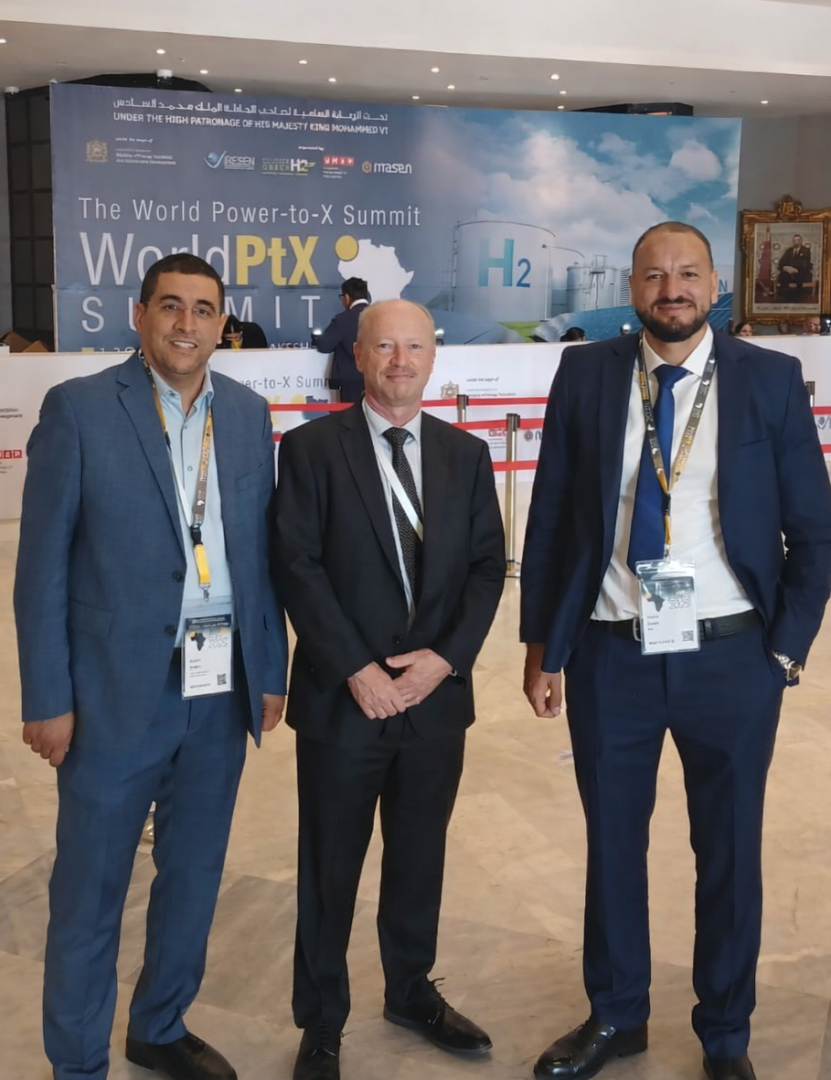
Joachim Janssen, CEO of IAPsolutions, in the center of the photo, with Moroccan partners at the WorldPtxSummit
Public support as a key factor
The project is supported by aid co-financed by the CDTI Innovation and European ERDF funds, a support that, according to Janssen, has been decisive for its viability. “The financing of CDTI Innovation and FEDER funds has been key to making this R&D project viable, especially as it is an international collaboration,” he says.
In this regard, he stresses that “a company with a commercial profile does not usually get involved early in international initiatives of this type without solid institutional support”. For the CEO of IAPsolutions, the public role goes beyond financial support: “It is especially relevant that CDTI promotes international cooperation in R&D, the export of Spanish technology and the creation of alliances with new partner countries.”
This approach, he adds, “not only benefits companies, but strengthens Europe’s position as a global technological actor, promotes knowledge transfer and generates tangible economic and social impacts”, both in terms of skilled employment and competitiveness and in the development of solutions with real social impact, such as sustainable access to drinking water in rural environments.
Environmental impact and local development
From an environmental point of view, the system developed by IAPsolutions contributes to reducing the pressure on natural water sources and promoting more responsible water management. The use of renewable energies, the efficiency of the process and the focus on modularity and circular economy allow to minimize the environmental impact and favor a development model compatible with the protection of ecosystems.
“The solution contributes to the preservation of local ecosystems by reducing the overexploitation of resources and promoting a more balanced use of water,” says Janssen, who highlights that the system design is designed to adapt to different water and climate conditions without compromising its sustainability.
The project also has a clear social dimension. Its implementation in environments with limited infrastructure can directly improve the well-being of communities, ensuring sustainable access to drinking water and strengthening local resilience.
“The solution strengthens local development through the creation of technical capabilities, local employment and operational autonomy,” explains the CEO of IAPsolutions. By reducing the dependency on highly specialized personnel and betting on local maintenance, the system generates a positive and lasting social and economic impact in the territories where it is implemented.
International projection and leap to the market
The international potential of the project is one of its main assets. Morocco is shaping up as the first strategic market, supported by local partners, institutional support and the involvement of entities such as IRESEN, Moroccan counterpart of the CDTI. From there, the solution has a natural projection towards the Arab world and other regions with high water scarcity.
In parallel, IAPsolutions is exploring strategic markets in the Middle East, such as the United Arab Emirates and Saudi Arabia, where interest has already been detected not only for this purification system, but also for other solutions of the company in the field of intelligent water management, such as intelligent irrigation.
“The industrial and commercial experience of IAPsolutions will be key to structuring the business model, adapting the solution to different markets and leading the transition from R&D to international marketing,” concludes Janssen, convinced that technological innovation, when oriented to social impact, can become a transforming tool on a global scale.
CDTI Innovation
The Center for Technological Development and Innovation, CDTI E.P.E. It is the innovation agency of the Ministry of Science, Innovation and Universities, whose objective is the promotion of technological innovation in the business environment. The mission of the CDTI is to ensure that the Spanish business fabric generates and transforms scientific and technical knowledge into globally competitive, sustainable and inclusive growth. In 2024, within the framework of a new strategic plan, the CDTI provided more than 2.3 billion euros of support to Spanish companies and startups.
More information:
Press Office
press@cdti.es
91-581.55.00
On the Internet
Website: www.cdti.es
On Linkedin: https://www.linkedin.com/company/29815
On X: https://twitter.com/CDTI_innovacion
On Youtube: https://www.youtube.com/user/CDTIoficial
This content is copyright © 2026 CDTI,EPE. The use and reproduction is allowed by citing the source and digital identity of CDTI (@CDTI_innovacion).