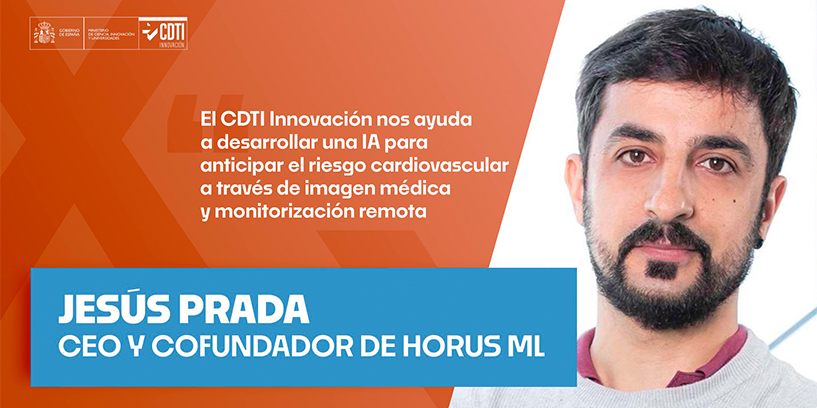
Jesús Prada, CEO and co-founder of HORUS ML: "The CDTI Innovation helps us develop an AI to anticipate cardiovascular risk through medical imaging and remote monitoring"
Detecting the disease earlier and better accompanying the patient are two of the great challenges of cardiovascular care. To address them, HORUS ML develops solutions based on artificial intelligence that analyze retinographs to improve the early detection of cardiovascular diseases and facilitate the follow-up of chronic patients
Cardiovascular diseases remain one of the great challenges of health systems. Its impact is not only measured in mortality figures but also in the difficulty of detecting in time processes that can progress silently for years and manifest themselves abruptly in the form of a heart attack or stroke.
In this context, HORUS ML works, a company incorporated in Madrid in 2022 that develops customized solutions based on artificial intelligence and machine learning for the healthcare sector. The company was born with a clear mission: to bring the real potential of artificial intelligence closer to clinical practice.
According to Jesús Prada, CEO and co-founder of HORUS ML, the team detected from the outset a gap between technological advances in machine learning and its effective application in hospitals and health centers. “Hospitals generate huge amounts of data, but they lacked specialized partners capable of transforming that information into useful tools for diagnosing, treating and monitoring patients,” he says.
That is why HORUS ML is not conceived as a company oriented to a single product, but as a centralized technological platform that integrates three large verticals: diagnostic imaging, precision medicine and remote monitoring of patients. A proposal that combines technological profiles specialized in AI with healthcare professionals with care experience, including practicing cardiologists. “AI in health only works when technological knowledge is combined with clinical vision,” says Prada.
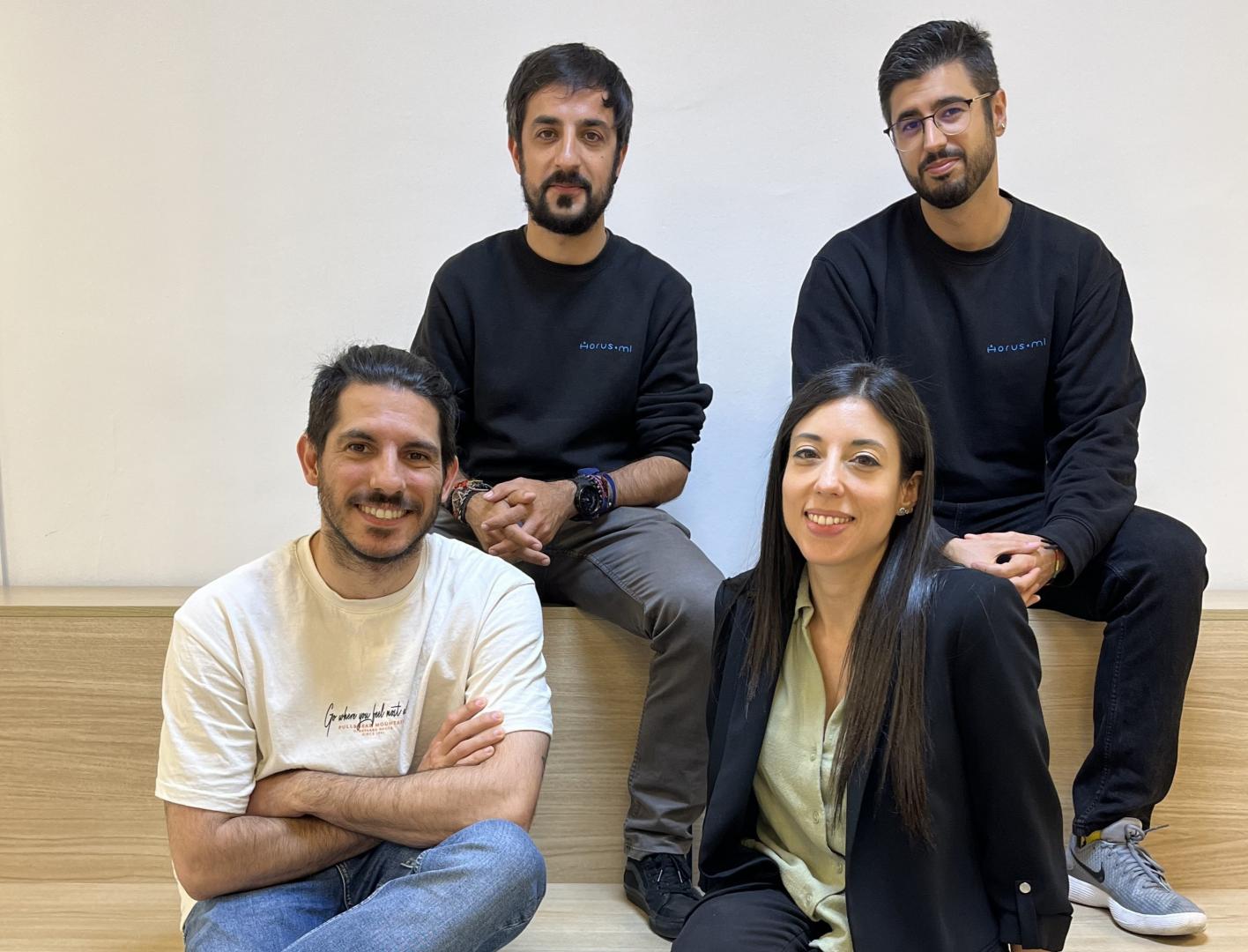
Horus ML team members
From early diagnosis to continuous follow-up
The HORUS ML project addresses two key moments in the journey of cardiovascular disease. The first is the early detection, especially of processes such as subclinical atherosclerosis, which can progress for years without causing symptoms. Prada summarizes the problem with a particularly illustrative fact: approximately half of the infarctions occur in people who are classified as low-risk by traditional scales. “There is a huge group of patients who are already sick and who the system is not looking at,” he explains.
To respond to this limitation, the company has developed an image diagnostic line based on artificial intelligence, aimed at facilitating the identification of the risk of atherosclerosis —the main cause of cardiovascular disease—, based on simple, accessible tests compatible with ordinary primary care activity.
The second moment is the follow-up of patients who already suffer from cardiovascular disease, especially people with chronic heart failure. In these cases, the problem is not only to diagnose but also to anticipate decompensations that can evolve very quickly and end in hospitalization. In contrast to a traditional model based on regular face-to-face visits, HORUS ML works on remote monitoring that allows us to move from reactive to continuous and proactive monitoring. “What connects both lines is the same idea: going from a reactive medicine, which acts when the damage has already been done, to a preventive and proactive medicine,” he says.
The retina as a window to the vascular system
One of the most advanced lines of the project is based on retinographic image analysis. Retinography is a photograph of the back of the eye that can be obtained in just a few seconds, without the need to dilate the pupil and without discomfort for the patient.
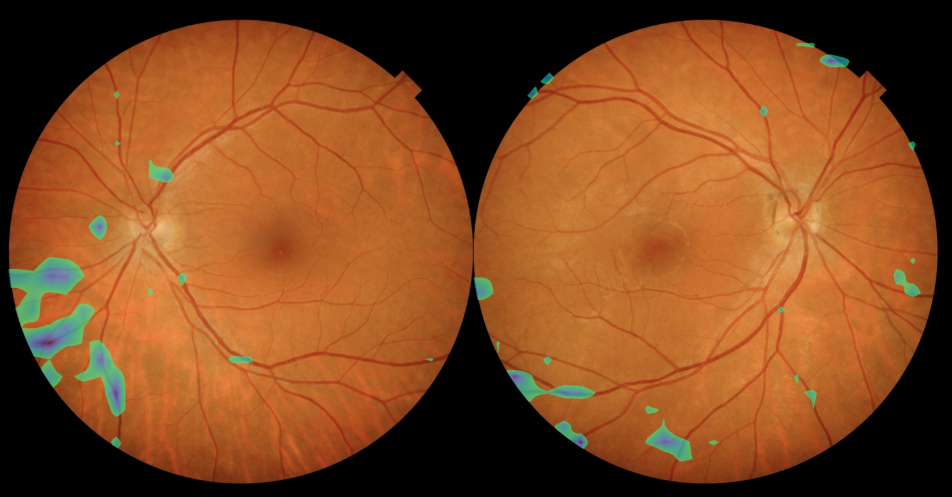
Retinography makes it possible to observe the blood vessels of the retina and detect signs associated with cardiovascular risk
The key is that the retina is the only place in the body where blood vessels can be seen directly by means of a simple image. Therefore, for HORUS ML, it represents a particularly promising way to detect signals related to vascular health. “The retina is literally a window into the vascular system,” Prada explains.
In these images, very subtle patterns associated with the presence of atherosclerosis can appear, such as variations in the caliber of the vessels or alterations in microvascularization. These are hard to detect signs for the human eye, but they can be identified by artificial intelligence models trained with thousands of images.
The HORUS ML proposal takes advantage of the wide implantation of non-mydriatic retinographs to turn a rapid, economical and non-invasive test into an atherosclerosis screening tool. After performing retinography, the image is automatically processed and, in less than ten seconds, the healthcare professional receives an assessment of the risk of atherosclerosis that supports decision-making.
For the company, the key is not only in precision, but also in the integration with the electronic clinical history and information systems of the health center. “A tool that doesn’t integrate into the real healthcare flow, however precise, ends up not being used,” says Prada.
In addition, the system incorporates an interpretability module that shows which areas of the image have most influenced the prediction, allowing the doctor to contrast the result with his own clinical judgment. If an elevated risk is detected, the patient may be referred for a vascular ultrasound, which remains the baseline test to confirm the diagnosis.
Remote monitoring for chronic patients
In addition to imaging, HORUS ML works on a remote monitoring line for patients with heart failure based on generative artificial intelligence. Through telephone calls in natural language, the system periodically follows the patient, collects information about his state of health and analyzes possible signs of deterioration.
Based on these data, a predictive model estimates the risk of decompensation and, if it detects signs of worsening, generates an alert for the medical team. “It’s not just about talking to the patient, but about anticipating the problem and warning in time to be able to intervene in a preventive way,” Prada explains.
The objective is to improve the quality of life and autonomy of patients, reduce avoidable hospitalizations and favor a more continuous and proactive follow-up.
The support needed to reach the clinical practice
The support of CDTI Innovation through the NEOTEC initiative has been key to the development of technology and the consolidation of HORUS ML. “This support has been one of the pillars that have made it possible for the project to exist as it is today,” says Prada.
As he explains, the funding has allowed the company to face complex processes such as clinical validation and regulatory requirements without giving up high-impact innovation. In addition, the support of a specialized public agency has strengthened the credibility of the project before hospitals, institutions and investors.
Overall, Prada believes that the CDTI has not only funded a specific development, but has also helped to consolidate HORUS ML as a company. “They are a fundamental lever so that innovation born in small companies can really have an impact,” he says.
Therefore, initiatives such as HORUS ML reflect the role of technological innovation in the transformation of the healthcare system and in the development of solutions with social and economic impact.
A more preventive, accessible and equitable medicine
For the next few years, the company proposes its evolution in three horizons. The first is to make your atherosclerosis screening tool, Aitheroscope, a standard solution in primary care in Spain. The aspiration is that a retinography to evaluate the risk of suffering atherosclerosis becomes as common as a cholesterol analysis or a stress taking.
Aitheroscope: screening tool for atherosclerosis
The second is to consolidate the company as a reference in artificial intelligence applied to cardiovascular diseases.
And finally, its third goal is to fully develop an integral platform that, through a single integration in the health system, allows access to different tools of artificial intelligence in health. With this, HORUS ML seeks to reduce technological fragmentation and facilitate the adoption of new solutions by health centers.
In this sense, the project is aligned with the Sustainable Development Goals. First of all, SDG 3, linked to health and well-being. Secondly, it contributes to SDG 5, related to gender equality, as it offers validated screening and prevention tools with balanced performance in both sexes, which help correct the cardiovascular under-diagnosis that has historically affected women. Finally, there is also an alignment with SDG 9, due to its commitment to technological innovation applied to a high-impact health challenge.
But, beyond the technological dimension, Prada insists that the ultimate goal is to contribute to a more preventive, accessible and equitable medicine. “If in a few years we have helped many people avoid a serious cardiovascular event that they would otherwise have suffered, we will have fulfilled what really moves us,” he concludes.
CDTI Innovation
The Center for Technological Development and Innovation, CDTI E.P.E. It is the innovation agency of the Ministry of Science, Innovation and Universities, whose objective is the promotion of technological innovation in the business environment. The mission of the CDTI is to ensure that the Spanish business fabric generates and transforms scientific and technical knowledge into globally competitive, sustainable and inclusive growth. In 2025, within the framework of the Strategic Plan 2024-2027, the CDTI provided 2,423 million euros of support to Spanish companies and startups.
More information:
Press Office
press@cdti.es
91-581.55.00
On the Internet
Website: www.cdti.es
On Linkedin: https://www.linkedin.com/company/29815
On X: https://twitter.com/CDTI_innovacion
On Youtube: https://www.youtube.com/user/CDTIoficial
This content is copyright © 2026 CDTI,EPE. The use and reproduction is allowed by citing the source and digital identity of CDTI (@CDTI_innovacion).