The CDTI Innovation seeks a Spanish company to develop with Egypt a virtual warehouse of raw materials based on artificial intelligence
The initiative aims to create a semantic interoperability system that allows different manufacturing companies to share and interpret information on materials and components, combining generative artificial intelligence and artificial vision.
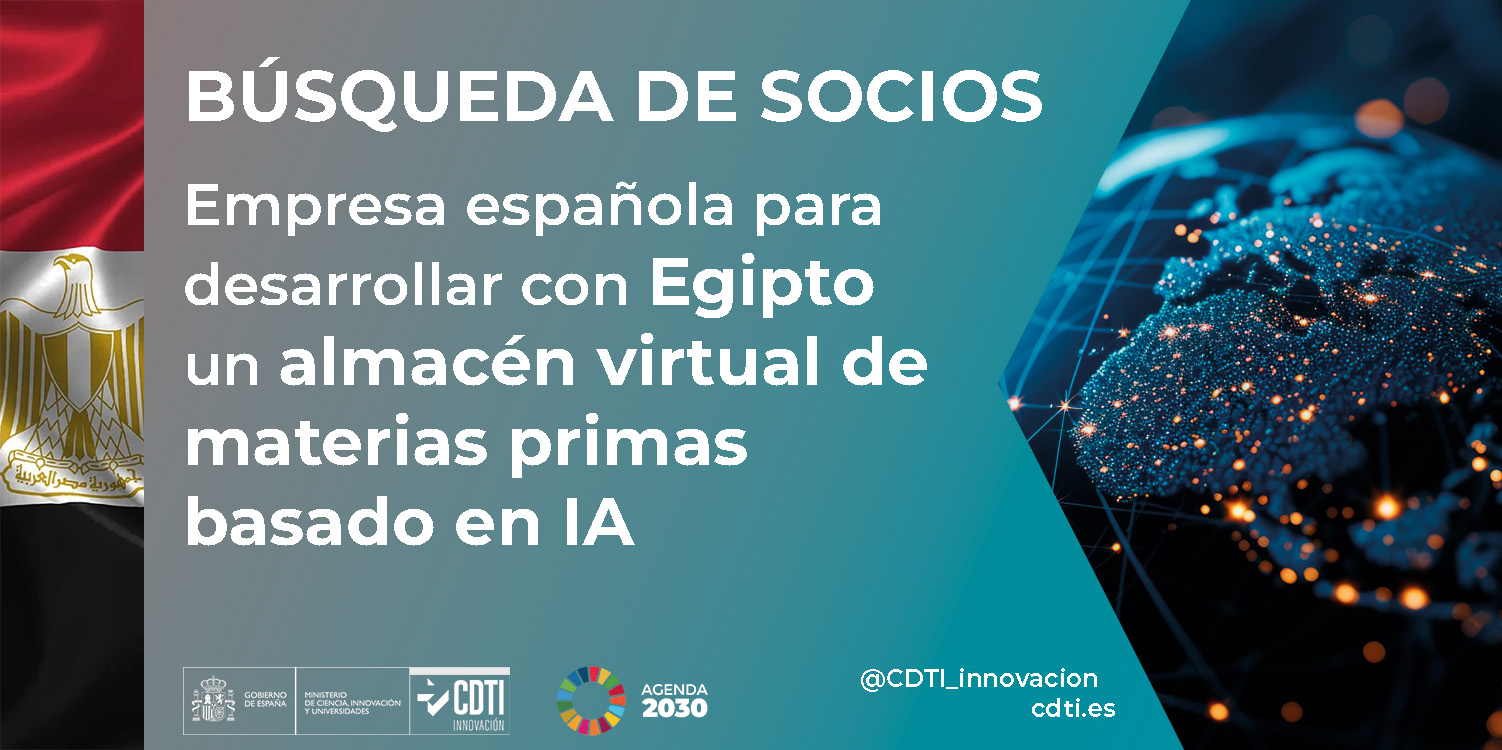
The MSA University of Egypt is looking for a Spanish company to collaborate in an R&D project focused on the development of a virtual warehouse of raw materials based on artificial intelligence, with the aim of improving interoperability between computer systems used in manufacturing processes.
The understanding of the meaning of a component, a raw material or a manufacturing resource depends, traditionally, on the human interpretation of the texts describing them. There may be different and even incompatible definitions, or different descriptions for the same concept, which makes it difficult to determine precisely to what extent they are equivalent.
Material descriptions are often based on informal textual definitions that can lead to multiple interpretations, some of which are inadequate, when several manufacturing companies use the same material or component to execute a production order. In areas such as conventional e-commerce platforms (e.g. Amazon), these differences can be resolved by people interacting with the app. However, this solution is much more complex in today’s collaborative manufacturing environments involving multiple information and communication technology (ICT) systems. To resolve these differences in meaning, it is necessary to resort to the exchange of knowledge based on semantics, so that information can also be understood by machines.
In this context, the project proposes to develop an adaptive semantic interoperability solution. Interoperability between companies should be based on the semantic exchange of data and not only on the exchange of information from a syntactic point of view. To this end, a coherent data ontology will be used, that is, a machine-readable model that defines the types, properties and relationships of the raw materials used in the manufacturing processes. This ontology acts as a semantic layer that allows computer systems and databases to understand what these materials are, how they behave and how they relate to each other. It is a fundamental concept in the engineering of knowledge applied to technical systems, which uses these semantic models to represent, organize and reason about knowledge, so that intelligent systems can understand and interact with information.
Having a single centralized ontology for all participants limits bilateral interoperability and creates significant barriers to adoption. Faced with this approach, the project proposes an adaptive and more flexible solution. To do this, it proposes to automatically generate a specific ontology on the sender's side, using generative AI, and publish it in an "ontology center" (Ontology Hub). Subsequently, any interested party can consult this center to locate the ontology of raw materials that they need.
To improve the accuracy of this matching, the system will incorporate a "Multimodal Material Competency Matrix", based on a hybrid AI approach that will combine two capabilities:
- Semantic AI: it will allow us to understand the technical relationships and functional behaviors of the materials.
- Visual AI (artificial vision): It will allow users to upload photographs of spare parts or raw materials. From them, the AI will extract its physical dimensions and distinctive characteristics, avoiding discrepancies derived from differences in textual nomenclature, language barriers and translation errors.
The search for a partner is led by Dr. Mohamed Ghanam, from MSA University, and is aimed at Spanish companies interested in collaborating in the development of this technological solution.
The proposal aims to present itself to the call for proposals 2026 Spain-Egypt for R&D, called ESIP (Egypt Spain Innovation Programme), whose deadline for submitting applications will remain open until December 3, 2026.
Interested entities can consult more information on the search for a partner and a summary of the proposal in this link.
Contact
For further information on the technical scope of the proposal and the role of the Spanish company, please contact Dr. Mohamed Ghanam via email: mghanam@msa.edu.eg.
For information and advice on this search for partners and/or the ESIP call, you can contact the Office of the Delegation of North Africa and Middle East of the CDTI Innovation:
- José Manuel Durán: josemanuel.duran@cdti.es
- Francisco Sánchez Quintana: francisco.sanchez@cdti.es
CDTI Innovation
The Center for Technological Development and Innovation, CDTI E.P.E. It is the innovation agency of the Ministry of Science, Innovation and Universities, whose objective is the promotion of technological innovation in the business environment. The mission of the CDTI is to ensure that the Spanish business fabric generates and transforms scientific and technical knowledge into globally competitive, sustainable and inclusive growth.
More information:
Press Office
press@cdti.es
91-581.55.00
On the Internet
Website: www.cdti.es
On Linkedin: https://www.linkedin.com/company/29815
On X: https://x.com/CDTI_innovacion
On Youtube: https://www.youtube.com/user/CDTIoficial
This content is copyright © 2026 CDTI, EPE. The use and reproduction is allowed by citing the source and digital identity of CDTI (@CDTI_innovacion).