The CDTI Innovation seeks a Spanish company to develop an R&D project with South Korea related to advanced materials for organic photovoltaic technology
The initiative seeks to develop new materials and manufacturing technologies to improve the efficiency and stability of organic solar cells and move towards their application in buildings, mobility and distributed energy harvesting systems.
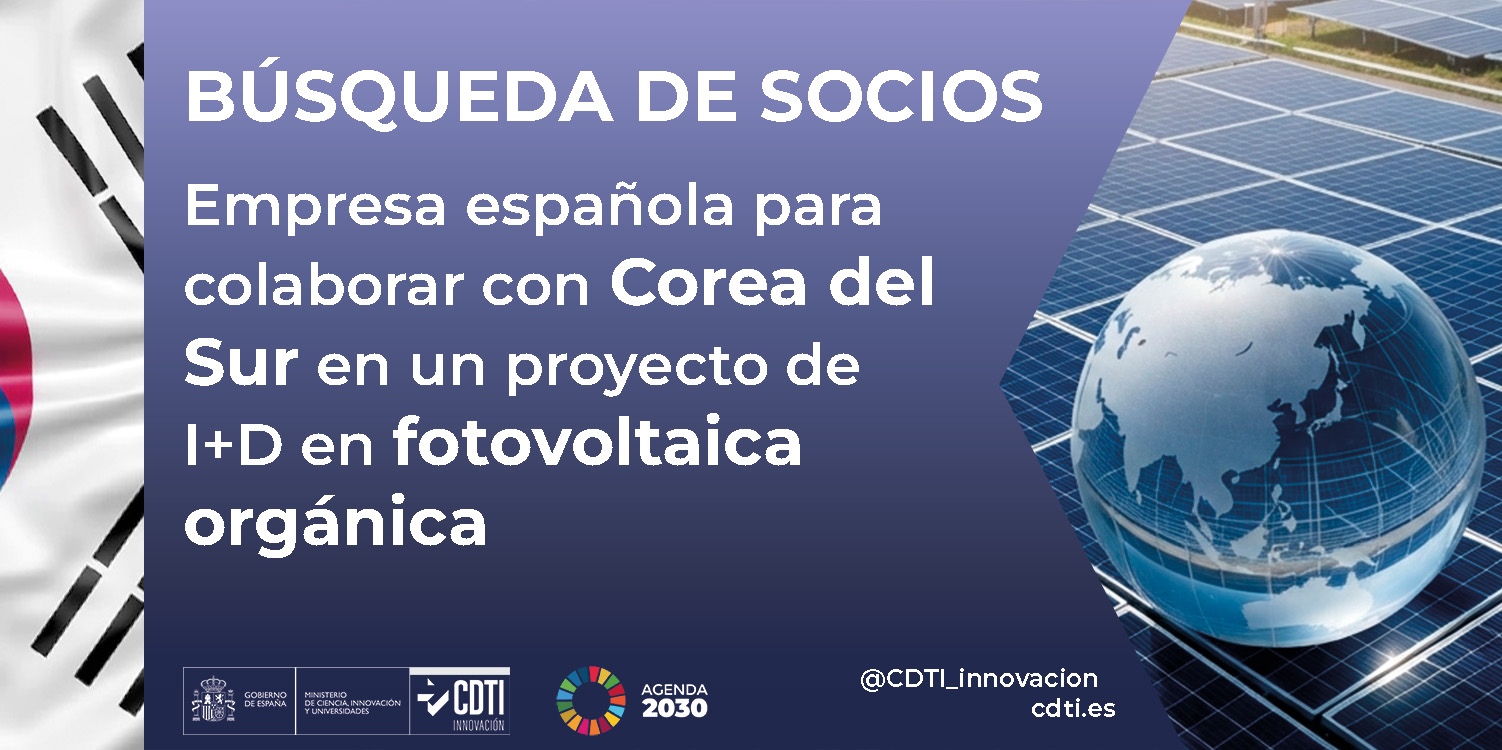
The Korea Electronics Technology Institute (KETI), a Korean public research center specializing in electronics, semiconductor technologies and materials, is looking for a Spanish company to develop an R&D project in the field of advanced materials for organic photovoltaic (OPV) technology.
Organic solar cells have advantages such as lightness, flexibility, semi-transparency and low temperature manufacturing capacity. These features make them suitable for applications where conventional crystalline silicon solar cells are more difficult to integrate. However, its commercial expansion remains constrained by challenges such as device lifetime, moisture and oxygen stability, transparent electrode performance, and uniformity of large-scale manufacturing processes.
The objective of the project is to develop new photoactive materials, electrode materials and encapsulation solutions, along with scalable manufacturing technologies that allow progress in the application of this technology in buildings with photovoltaic integration (BIPV), mobility and distributed energy harvesting systems.
Within the framework of this collaboration, the Spanish consortium will develop and optimize high-efficiency organic photoactive materials and/or advanced barrier and encapsulation materials that improve the stability of the devices against environmental conditions. For its part, the Korean consortium will work on high-surface transparent electrode and substrate technologies, as well as on electrode structuring processes and integration of devices suitable for semi-transparent organic photovoltaic modules.
Both parties will jointly optimize optical transparency, electrical conductivity, conversion efficiency and long-term stability. As a result, a large surface semi-transparent organic photovoltaic demonstrator will be manufactured.
We are looking for Spanish companies with experience in one or more of the following areas:
- Organic photovoltaic materials, including donor and acceptor materials, and formulation of photoactive layers.
- Design of high-efficiency and long-life organic photovoltaic (OPV) devices, especially for semi-transparent applications.
- Barrier, encapsulation and interface materials to improve stability against moisture, oxygen and temperature.
- Coating of large surfaces in OPV devices, module manufacturing and optical and electrical characterization.
The proposal aims to be submitted to the call for proposals 2026-2027 of the Korea-Spain Strategic Programme (KSSP), open until 28 January 2027.
Contact
For additional information on the technical scope of the proposal and the role of Spanish companies, interested entities can contact Mr. Donghee Lee, via email: Don@intreelab.com.
In addition, a virtual space has been enabled on LinkedIn so that interested entities can present their project ideas and look for potential partners to form an international consortium: MATCHMAKING PLATFORM FOR THE KOREA SPAIN STRATEGIC PROGRAM (KSSP) ON ADVANCED MATERIALS.
CDTI Innovation
The Center for Technological Development and Innovation, CDTI E.P.E. It is the innovation agency of the Ministry of Science, Innovation and Universities, whose objective is the promotion of technological innovation in the business environment. The mission of the CDTI is to ensure that the Spanish business fabric generates and transforms scientific and technical knowledge into globally competitive, sustainable and inclusive growth.
More information:
Press Office
press@cdti.es
91-581.55.00
On the Internet
Website: www.cdti.es
On Linkedin: https://www.linkedin.com/company/29815
On X: https://x.com/CDTI_innovacion
On Youtube: https://www.youtube.com/user/CDTIoficial
This content is copyright © 2026 CDTI, EPE. The use and reproduction is allowed by citing the source and digital identity of CDTI (@CDTI_innovacion).