Celeste Guzmán, head of R&D at Bioline Iberia: “The financing of the CDTI Innovation and the FEDER funds allows us to advance in the biological control of agricultural pests with greater technical solidity”
The promotion of R&D in biological solutions for agriculture is opening up new ways to combat pests in a more sustainable way. With the support of the CDTI Innovation and the cofinancing of the European FEDER funds, Bioline Iberia develops the Revolumites project, aimed at optimizing the production of predatory mites and strengthening the role of biological control as an effective alternative against chemical treatments.
Since its creation in 2018, Bioline Iberia has focused its activity on promoting innovative solutions for integrated pest management in agriculture. La empresa nació a partir de una joint venture entre la compañía almeriense Biocolor S.L. and the multinational Bioline Agrosciences, specialized in the development of biological solutions for plant health. The combination of Bioline Agrosciences’ international research expertise—with more than ten patents and five research centers in different countries—and Biocolor’s technical and logistical knowledge in the Spanish agricultural field resulted in a company focused on bringing technological innovation to the field.
“Bioline Agrosciences has been a pioneer in the development and implementation of auxiliary fauna in greenhouses for almost 30 years,” explains Celeste Guzmán, head of Bioline Iberia’s R&D Department, who underlines that the Spanish subsidiary’s objective was from the beginning to consolidate itself as a technological partner for farmers, capable of offering effective solutions against pests through biological control strategies.
Today the company has 68 employees, six of them dedicated specifically to R&D activities, and has managed to position itself as one of the relevant actors in the supply of natural tools for the protection of fruit and vegetable crops and ornamentals. Its catalog includes a wide range of predatory and parasitoid mites and insects, such as Amblyseius swirskii, Neoseiulus californicus, Orius laevigatus or Aphidius spp., among many other beneficial organisms that contribute to the natural control of pests. To these solutions are added nematodes, pheromones, adhesive traps, microbiological products, pollinating insects and biostimulants, configuring an integral porfolio oriented to sustainable agriculture.
Beyond the products, Guzmán also highlights the value of the technical support offered by the company. “We have a team of specialists who carry out on-farm visits to evaluate the real problems of farmers and propose solutions adapted to each situation,” he explains. This approach is complemented by specialized logistics that allow live organisms to be delivered in optimal conditions, through refrigerated shipments and direct distribution in the field or in cooperatives.
Currently, Bioline Iberia has around 12% of the market share in its main segment within Spain. As for its exports, the company is already present in several European countries —such as France, Italy, Greece, Hungary, Croatia or Portugal— and in international markets such as the United Kingdom, Mexico, Morocco, Egypt or Senegal. “International expansion is part of our strategic objectives and we are actively working on it,” says Guzmán.
Innovation applied to biological control
In this context of growth and consolidation, innovation plays a central role in the company’s strategy. Bioline Iberia allocates approximately 8% of its turnover to R&D activities, with the aim of improving the effectiveness and accessibility of the biological solutions available to farmers.
In recent years, the company has promoted the development of new formats and technologies that facilitate the application of biological control, from controlled release systems to patented devices such as T-protect®, Bugline® or Stickline®, in addition to recent innovations such as Duo® systems. It has also advanced the industrialization of beneficial organism release processes, through encapsulation technologies and new field application tools, including drone or spray release solutions.
“Throughout these decades we have been turning innovation into practical tools that make biological control easier, faster and more reliable for farmers,” says Guzmán. In this line, there are also newly introduced formats on the market, designed to save time on farms and ensure the effectiveness of the product, such as Chrysoline Eggline.
Predatory Mites
One of the most relevant projects in which Bioline Iberia currently works is Revolumites, an R&D initiative focused on the development of new production strategies for predatory mites, especially of the species Amblyseius swirskii, one of the key organisms in the biological control of agricultural pests.
The context in which this research emerges is marked by a profound change in the agricultural sector. “Intensive agriculture faces a growing challenge: reducing the use of chemical pesticides, driven both by stricter regulations and consumer demand for safer and more sustainable food,” Guzman explains.
In this scenario, Amblyseius swirskii has been consolidated as a fundamental tool to combat pests as relevant as white fly or different species of insect trips, including Thrips parvispinus, currently considered one of the main threats for protected crops such as pepper or cucumber. However, the current production methods of these organisms have limitations that hinder their scalability.
“Current breeding systems have their challenges in terms of cost and efficiency,” says the R&D manager. The objective of the project is precisely to overcome these challenges through the development of an innovative diet and the optimization of production processes, in order to significantly increase the density of mites obtained in each breeding unit.
The ultimate goal is to increase the concentration of individuals available for marketing and improve the performance of the production system. “We seek to offer a more effective and sustainable solution for pest control in agriculture,” Guzmán summarizes.
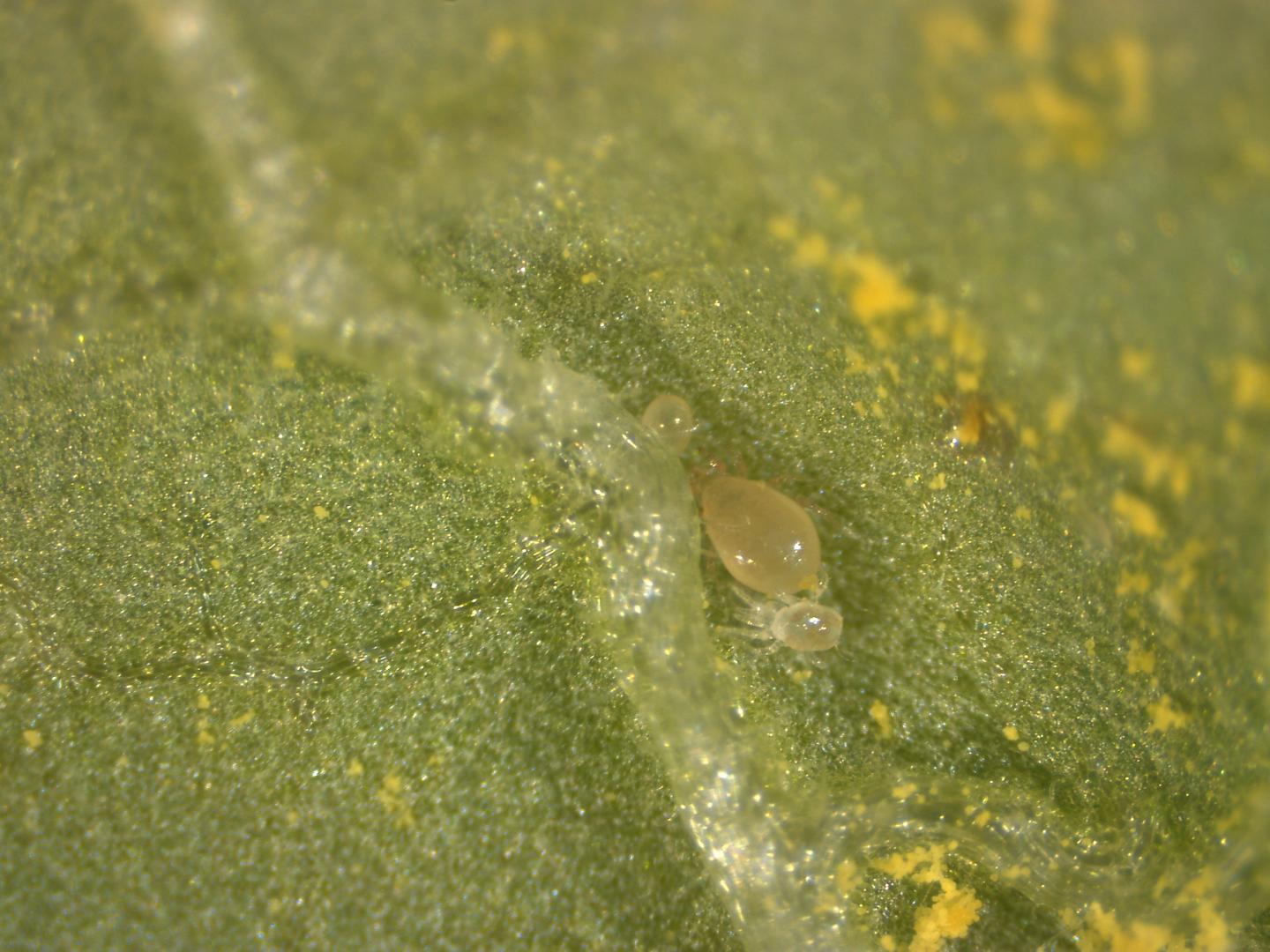
Female, larva and egg of A. swirskii
Multidisciplinary research
The development of this innovation involves addressing a complex biological system in which multiple factors are involved. The breeding of predatory mites requires managing a complete trophic chain, in which not only the predator but also its prey are reproduced, in addition to other elements that intervene in the productive process.
“We are working with a system that involves the interaction between predator, prey, substrates, diet formulations and controlled environmental conditions,” explains Guzmán. Each of these factors can influence both the productivity and the quality of the final product.
In addition, all stages of the process—from the start of breeding to final packaging—have an impact on system performance. “That implies an enormous need for control, analysis and coordination between different departments,” he adds. For this reason, Revolumites is considered as a highly multidisciplinary project, in which different areas of the company participate.
Collaboration with the agricultural sector
Once the initial phases of development in the laboratory have been completed, the project contemplates its validation in real cultivation conditions. To this end, Bioline Iberia works closely with agricultural cooperatives and producers in the sector.
“In the validation phase, we will conduct field trials on pepper and cucumber crops to analyze the establishment of mite populations and their real pest control capacity,” explains Guzmán. These tests will be carried out in different climatic seasons, especially during the summer months, coinciding with the most intense agricultural campaigns.
Collaboration with farmers is essential to ensure the viability of innovation. “Many of these tests are carried out on commercial plots, which reflect the real conditions in which the product must work,” he says.
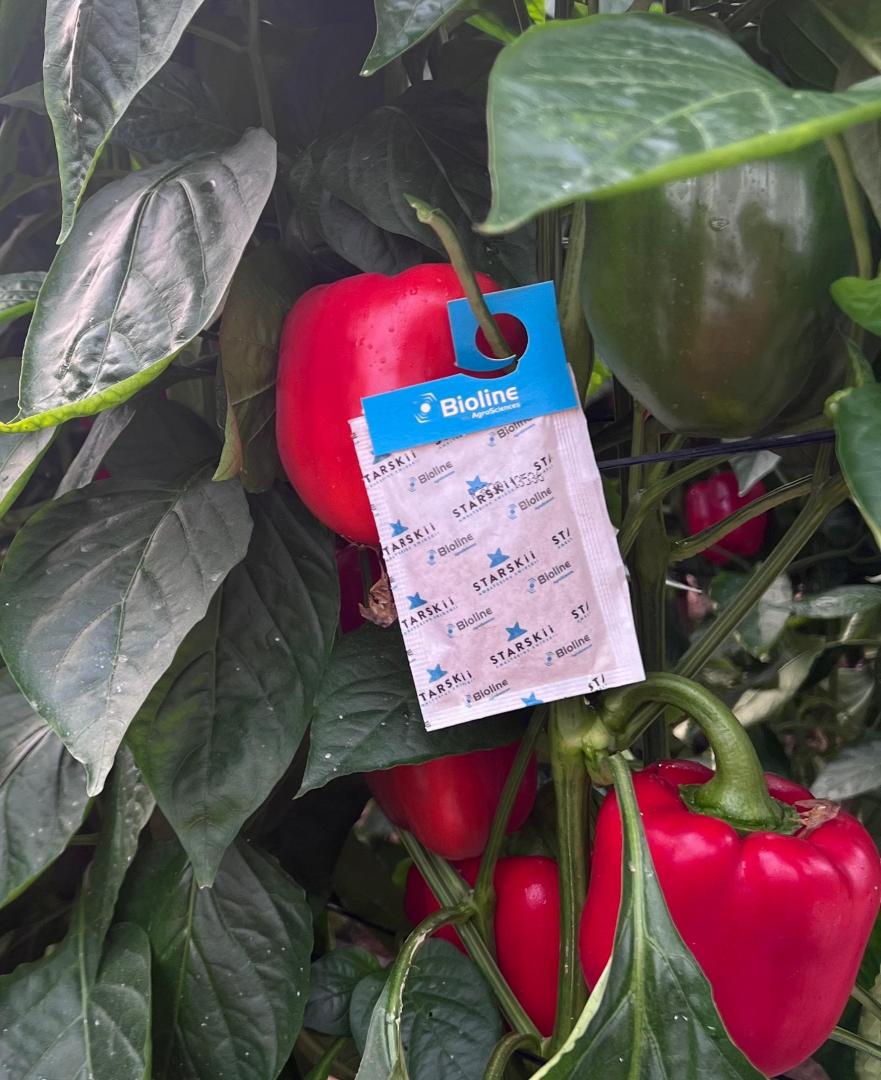
A. swirskii release envelope in pepper culture
A more sustainable agricultural model
Beyond the improvement in production processes, the Revolumites project seeks to reinforce the role of biological control as a sustainable alternative to chemical treatments in agriculture.
“The use of chemical pesticides has significant disadvantages, both from the point of view of application safety and food safety or the appearance of resistance,” explains Guzmán. On the other hand, the use of high-quality predatory organisms contributes to improving crop health and reducing the dependency on these substances.
In this sense, the development of new production strategies for predatory mites can have a significant impact on the entire agri-food chain. “Promoting biological control benefits farmers, consumers and society as a whole,” he says.
Public financing as a lever
The advancement of such a project requires significant investments in research and development. In this context, institutional support has played an important role in accelerating its development.
“The financing co-financed by the CDTI Innovation and European ERDF funds has been decisive for Bioline Iberia because it reduces the risk of R&D and allows us to advance the Revolumites project with greater technical solidity,” explains Guzmán. Thanks to this support, the company has been able to intensify the tests, reinforce specialized resources and accelerate the development of new feeding strategies for the mass breeding of predatory mites.
This boost not only benefits the company but also the whole of the innovative ecosystem. “This type of European financing acts as a lever to mobilize investment, generate qualified employment and increase the competitiveness of innovative companies in Spain,” he says.
In addition, according to Guzmán, the impact transcends the business environment. “It contributes to promoting a more sustainable agricultural model, favoring biological control over chemical solutions, improving crop resilience and strengthening the security and sustainability of the food system.”
Plans for the future
The learning obtained at Revolumites will allow Bioline Iberia to expand its knowledge about the production systems of beneficial organisms and guide new fields of research. “The optimization of production processes and the implementation of new lines must always be a goal for any production company,” says Guzmán.
In this sense, the project will serve as a basis for the development of future initiatives focused on other species of mites, as well as predatory and parasitoid insects used in biological control.
In the medium term, the company hopes that the results obtained will contribute to strengthening its position in the market. “Our goal is for this project to allow us to continue expanding our market share both nationally and internationally,” he says.
But the expected impact goes beyond business growth. “We trust that initiatives like this will continue to favour the use of biological control organisms, which even in a climate change context remains the most sustainable solution for the control of agricultural pests,” concludes Celeste Guzmán.
CDTI Innovation
The Center for Technological Development and Innovation, CDTI E.P.E. It is the innovation agency of the Ministry of Science, Innovation and Universities, whose objective is the promotion of technological innovation in the business environment. The mission of the CDTI is to ensure that the Spanish business fabric generates and transforms scientific and technical knowledge into globally competitive, sustainable and inclusive growth. In 2025, within the framework of the Strategic Plan 2024-2027, the CDTI provided more than 2 billion euros of support to Spanish companies and startups.
More information:
Press Office
press@cdti.es
91-581.55.00
On the Internet
Website: www.cdti.es
On Linkedin: https://www.linkedin.com/company/29815
On X: https://twitter.com/CDTI_innovacion
On Youtube: https://www.youtube.com/user/CDTIoficial
This content is copyright © 2026 CDTI,EPE. The use and reproduction is allowed by citing the source and digital identity of CDTI (@CDTI_innovacion).